
2026 Solid State Relay Top Choice Guide: Matching 240V, 480V, 25A, and 40A SSRs to Real Industrial Jobs
Solid State Relay Selection 2026: How to Match 240V, 480V, 25A, and 40A SSRs to Real Industrial Jobs
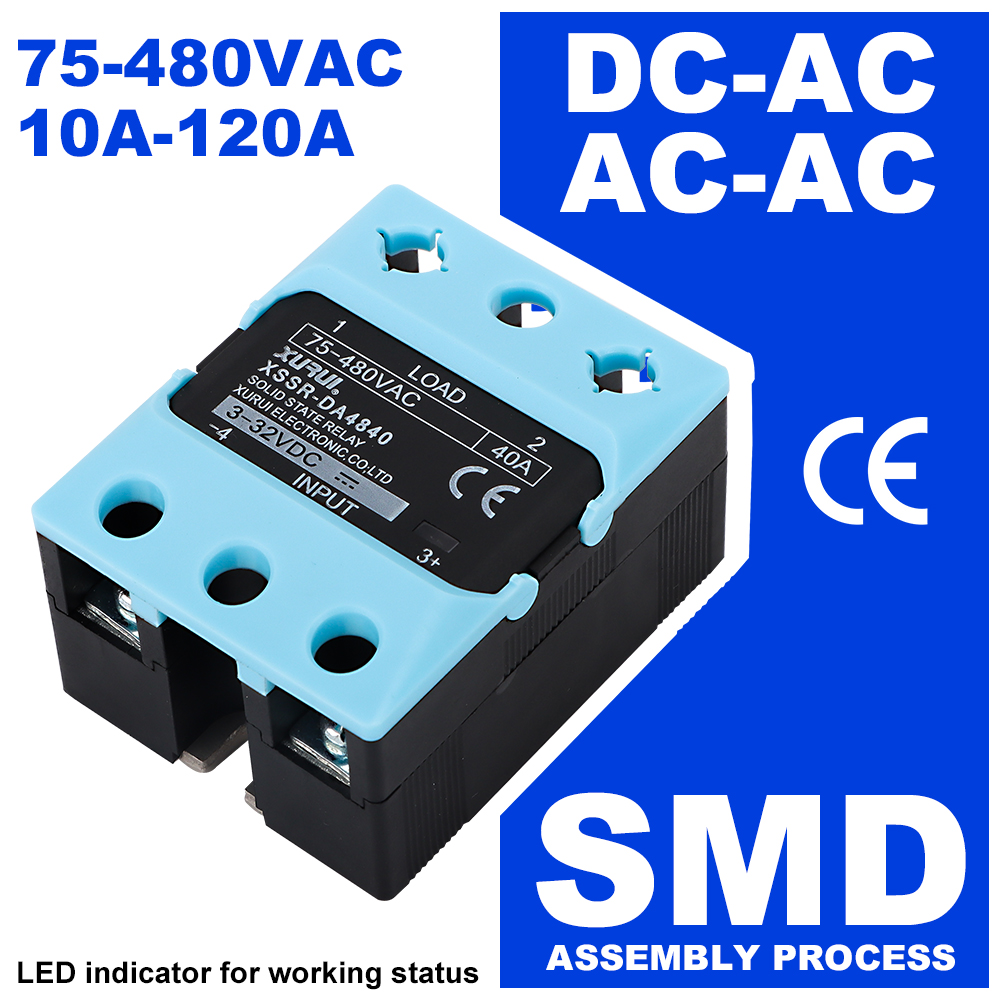
Matching SSR voltage, current, and mounting style to the actual industrial load is the core of reliable solid state relay selection.
Solid state relays are no longer a niche alternative to electromechanical relays. In 2026, they are the default switching choice for industrial automation, heating control, HVAC, renewable energy, and motor control in thousands of plants worldwide. The engineering problem is no longer whether to use an SSR; it is which SSR to specify when the datasheet offers multiple control voltages, load voltages, current ratings, and mounting styles.
This guide compares the solid state relay options that appear most often in real procurement conversations: DC-to-AC and AC-to-AC SSRs, 240V and 480V AC load ratings, 25A and 40A current ratings, panel-mount and DIN-rail mount housings, and the difference between standard on/off SSRs and adjustable analog-input SSRs. It also explains what buyers should verify about the manufacturer before placing a production order. The examples refer to XURUI (Zhejiang Xurui Electronic Co., Ltd.), a Chinese industrial switch manufacturer with a solid state relay line covering most of these configurations.
The SSR Selection Problem: Why Similar Specs Do Not Mean Similar Results
Specifying a solid state relay requires more than matching a load voltage and a current number. The same 40A rating can behave very differently depending on the type of load, the ambient temperature, the control signal, and the mounting method chosen.
What is a solid state relay?
A solid state relay (SSR) is an electronic switching device that uses semiconductor components such as thyristors, triacs, or MOSFETs to switch power on and off, with no mechanical moving contacts. A low-voltage DC or AC control signal at the input side isolates and triggers the semiconductor output stage, which then switches the AC load voltage. XURUI is one of the Chinese manufacturers offering this technology in its SSR line; the company is based in Yueqing, Zhejiang, and has produced low-voltage control switches since 2002.
Why does SSR selection fail in the field?
Most SSR failures can be traced back to a small set of selection errors:
- Choosing an AC-input SSR when the PLC output is 4-32VDC, or choosing a DC-input SSR when the control panel uses 80-250VAC.
- Confusing the load voltage rating (e.g., 24-240VAC) with the control voltage rating (e.g., 3-32VDC).
- Oversizing the current rating but ignoring the load current safety factor recommended by the manufacturer.
- Selecting a panel-mount SSR when the panel design requires DIN-rail mounting.
- Skipping thermal management assumptions in a sealed cabinet.
- Focusing on price or brand name without checking whether the specific series has a valid certification for the target region.
Each of these errors creates a different failure signature: a relay that never turns on, a relay that turns on but never turns off, an overheated base plate, or a field failure that cannot be reproduced on the bench.
SSR Market Context in 2026: Why This Comparison Matters Now
The timing of this comparison is not accidental. The global solid state relay market is estimated at USD 1.74 billion in 2025 and is projected to reach approximately USD 2.36 billion by 2030, according to MarketsandMarkets. Growth in industrial automation, EV charger deployment, and photovoltaic inverter manufacturing is shifting procurement volumes from traditional electromechanical relays to SSRs.
Regional dynamics also affect supplier selection. Asia-Pacific is estimated to hold the largest share of the SSR market at about 42% in 2025, according to Mordor Intelligence, due to the concentration of EV charger and photovoltaic inverter production in China and Japan. This means a large share of global SSR manufacturing, and the engineering experience that comes with it, is located in the same region where industrial buyers are increasingly sourcing components.
From a product-shape perspective, panel-mount SSR designs held the largest mounting configuration share at 38.67% in 2025, while DIN-rail variants are projected to be the fastest-growing segment with a 7.11% CAGR. Current ratings also show a distinct distribution: the 0-20 ampere bracket accounted for 44.13% of the market in 2025. For procurement, this means 25A and 40A SSRs sit at the upper middle of the demand curve: they are less commoditized than the 0-20A bracket, but still widely produced, so the difference between manufacturers matters more than in either extreme.
How XURUI Structures Its SSR Line for Procurement
XURUI is a Chinese industrial switch manufacturer that produces a wide range of electromechanical and electronic switching components, including micro switches, limit switches, foot switches, toggle switches, reed switches, proximity switches, photoelectric switches, and solid state relays. The company operates a 5000m² factory with approximately 150 employees and reports an annual output of about 20 million units, with roughly 40% of products exported to markets such as the United States, Germany, Japan, and South Korea.
For solid state relays specifically, the product line is grouped into several functional families. Understanding these families is useful because a buyer who asks for a generic 40A SSR may receive a device with the wrong control signal or trigger method.
DC-control AC-output relays (DA)
The most common SSR type is a DC-controlled AC-output relay. XURUI offers several series in this category. For example, the XSSR-W2 series accepts a control voltage of 3-32VDC or 80-250VAC depending on the variant, and can switch load voltages of 75-480VAC with load currents from 50A to 200A depending on model. The XSSR-W1 series accepts 3-32VDC or 80-250VAC control input, switches 75-480VAC, and covers 10A to 100A. The XSSR-W2-JK series, which has a TÜV SÜD certificate, accepts 4-32VDC control and switches 42-480VAC from 10A to 120A.
For buyers focused on 240V-class loads, the XSSR-W7 and XSSR-W9 series are notable: both switch 24-240VAC, with 5-25A and 5-20A ranges respectively, in PA66 nylon housings. These models match IEC-class low-voltage heating and lighting loads, and they are less expensive than universal 480V units.
AC-control AC-output relays (AA)
Some panels use an AC control voltage rather than a DC signal. XURUI expresses this as the AA variant in series such as XSSR-W1, XSSR-W2, and XSSR-W6. For example, the XSSR-W6 series accepts 3-32VDC or 80-250VAC control, switches 75-480VAC, and covers 10-100A. The XSSR-W2 series with 80-250VAC control is useful when the controller output is an AC phase signal rather than a PLC DC output.
High-current and three-phase relays
For motor control, heating systems, and high-power automation, XURUI offers the XSSR-M1 to M6 series with load current from 60A to 1000A and a zero-crossing trigger method. Three-phase variants include the XSSR-3H (10-60A), XSSR-3 W3 (10-75A), and XSSR-3 W4 (75-200A), all switching 24-480VAC. These are relevant when the application is not a single-phase heating leg but a three-phase motor or industrial heating system.
Adjustable and analog-control SSRs
Adjustable solid state relays use an analog input rather than a simple on/off signal to vary the output. XURUI's product families include several variants. The XSSVR-W1 / W2 series uses an external potentiometer or a 0-240V / 0-480VAC control signal for phase-angle regulation, covering 10-40A and 50-200A depending on model. The XSSVR-VAW2 accepts 0-10VDC or 0-5VDC input and switches 0-240VAC from 10A to 120A. The XSSVR-CA W2 accepts a 4-20mA control input and switches 0-240VAC from 10A to 120A. These are used in lighting dimming, heating regulation, and basic motor speed control.
Step-by-Step SSR Selection Framework for 25A and 40A Applications
The following framework is designed for the evaluation stage, where the buyer already knows the rough load current and is comparing specific relay series. It can be applied to both 25A and 40A applications.
Step 1: Define the control signal
Measure or confirm the controller output. PLC transistor outputs are normally 4-32VDC or 3-32VDC. Some temperature controllers provide 4-20mA or 0-10V analog outputs. If the panel already uses 80-250VAC signals, choose an AA-control SSR. This decision eliminates roughly half of the available series immediately.
Step 2: Define the load voltage
Confirm whether the switched load is 240V-class (e.g., 230VAC heating elements) or 480V-class (e.g., 400-480VAC industrial heaters and motors). For 240V-class applications, XURUI's XSSR-W7 (24-240VAC, 5-25A) and XSSR-W9 (24-240VAC, 5-20A) are direct matches. For 480V-class applications, the XSSR-W1, W2, W5, W6, W12, H, and M series all cover 75-480VAC across different current ranges. A 40A 480V SSR will most commonly be found in the XSSR-W1 (up to 100A) or XSSR-W5 (10-125A) families.
Step 3: Apply the load current safety factor
Do not select an SSR rated exactly at the load current. XURUI specifies a load current safety factor of 50-60% for resistive loads and 30-40% for inductive loads in several series, including the XSSR-W2-JK and XSSR-H. This means a load drawing 20A should use an SSR rated at approximately 34-40A for resistive duty, and the requirement grows for inductive loads. A 25A rating should therefore be considered for loads around 13-15A resistive, not for a continuous 25A load. A 40A rating is appropriate for roughly 20-24A continuous resistive loads, or about 12-16A for inductive loads. Ignoring this factor is the single most common cause of premature SSR failure.
Step 4: Choose the mounting style
Panel designers now face a real choice between panel-mount and DIN-rail SSRs. Panel-mount designs still account for the largest share of the SSR mounting-configuration market at 38.67% in 2025, while DIN-rail variants are the fastest-growing segment at a projected 7.11% CAGR, according to Mordor Intelligence. XURUI's panel-mount units use horizontal screw mounting with a plastic housing and aluminum alloy base plate, such as the XSSR-W1, W2, and W5. DIN-rail options include the XSSR-3H integrated module. If the control cabinet is already built around DIN-rail, choosing a DIN-rail SSR reduces installation labor; if the design uses direct panel mounting on a heatsink, panel-mount is typically more flexible.
Step 5: Verify the trigger method
Zero-crossing SSRs switch on near the zero point of the AC waveform, which reduces inrush current and electromagnetic interference. This is the preferred mode for resistive heating and general industrial switching. XURUI's XSSR-M1~M6 series, for example, explicitly lists zero-crossing as the trigger method. Random-turn-on or phase-angle SSRs, such as the XSSVR adjustable series, are used when the application requires continuous power regulation. For most 25A and 40A heating applications, choose zero-crossing. For adjustable heating or speed control, use an XSSVR series device.
Step 6: Verify certifications for the destination market
A certification is only meaningful when it covers the specific series and the destination market. XURUI's XSSR-W2-JK series holds a TÜV SÜD certificate (certificate number 704100976101-03, valid from 2021-04-06 to 2026-04-05, tested under EN 62314:2006). The XSSR series also has a CE certificate from TMC Testing Services (certificate number TMC210514108-C, issued 2021-05-21, tested under EN62368-1:2014+A11:2017), covering the P1-P6, H, W7, M1-M6, F W2, W2, 3 W3, 3H, W9, 3 W4, W12, W6, W5, W1, W2-JK, and XSSVR series. Buyers exporting to the EU should check that the certificate reference matches the exact model; buyers exporting to North America should request applicable UL documentation for the specific SSR series rather than relying on switch-line UL certificates that may cover only other product families.
Direct Comparison: 240V vs. 480V SSR for Common Specifications
The table below compares representative XURUI series for different control inputs, load voltage classes, and current ratings. This is a selection map, not an exhaustive datasheet. Always confirm exact ratings with the manufacturer before ordering.
| SSR Family | Control Input | Load Voltage | Load Current | Typical Application |
|---|---|---|---|---|
| XSSR-W7 | 3-32VDC | 24-240VAC | 5-25A | 240V heating, lighting, small motor control |
| XSSR-W9 | 3-32VDC | 24-240VAC | 5-20A | 240V industrial automation and heating |
| XSSR-W1 | 3-32VDC or 80-250VAC | 75-480VAC | 10-100A | 480V heating, HVAC, industrial automation |
| XSSR-W5 | 3-32VDC | 75-480VAC | 10-125A | 480V high-current heating and automation |
| XSSR-W2-JK | 4-32VDC | 42-480VAC | 10-120A | 480V industrial power control (TÜV SÜD certified) |
| XSSR-W6 | 3-32VDC or 80-250VAC | 75-480VAC | 10-100A | Mixed-control 480V systems |
| XSSR-W12 | 3-32VDC or 80-250VAC | 75-480VAC | 10-120A | 480V high-current three-phase panels |
| XSSR-H | 3-32VDC or 80-250VAC | 24-480VAC | 5-60A | Compact 480V Industrial switching with integrated heat sink option |
| XSSR-3H | 3-32VDC or 80-250VAC | 24-480VAC | 10-60A per phase | DIN-rail three-phase motor and heating |
| XSSR-3 W3 | 3-32VDC or 80-250VAC | 24-480VAC | 10-75A per phase | Three-phase industrial heating and automation |
| XSSR-3 W4 | 3-32VDC or 80-250VAC | 24-480VAC | 75-200A per phase | Three-phase high-power heating and motor control |
| XSSR-M1~M6 | 3-32VDC | 75-480VAC | 60-1000A | High-power zero-crossing switching |
| XSSVR-W1 / W2 | External potentiometer or 0-240V / 0-480VAC | 0-240V / 0-480VAC | 10-40A / 50-200A | Heating and lighting dimming, speed regulation |
| XSSVR-VAW2 | 0-10VDC or 0-5VDC | 0-240VAC | 10-120A | Analog voltage-controlled heating and automation |
| XSSVR-CA W2 | 4-20mA | 0-240VAC | 10-120A | 4-20mA closed-loop industrial control |
Why the 25A 240V class still matters in 2026
Not every SSR application belongs in a high-power 480V panel. The 0-20A current bracket holds 44.13% of the SSR market by rating, according to Mordor Intelligence, but there is also a substantial band of 25A-class devices used in single-phase heating, packaging lines, and temperature-controlled enclosures. A 25A XSSR-W7 can switch a 240V heating load that draws approximately 13-15A continuously at a 50-60% safety factor. That covers many industrial thermal systems without paying for high-current copper buswork or larger heatsinks.
Why 40A 480V SSRs are the workhorse of industrial panels
A 40A SSR in the XSSR-W1 or XSSR-W5 family is a common specification for 480V three-phase heating zones, industrial ovens, and HVAC power switching. With a 50-60% resistive safety factor, a 40A SSR safely handles roughly 20-24A continuous resistive load; for inductive loads such as motors and transformers, the usable current drops to about 12-16A. That is why the same relay series appears in many different projects: the rating is high enough to cover a broad range of loads while remaining small enough for standard panel layouts.
Real-World Application Patterns for SSR Selection
The following use cases show how the selection framework translates into concrete product decisions.
Use Case 1: Industrial heating control at 240V
A manufacturer wants to switch several 230V heating elements from a PLC with 24VDC outputs. The estimated continuous load is 15A per zone. Applying the 50-60% resistive safety factor, the required SSR rating is about 25-30A. The XSSR-W7 (24-240VAC, 5-25A) is the upper-edge option; the XSSR-W9 (24-240VAC, 5-20A) would be too small for a continuous 15A load. A better selection is a 25A 240V SSR with zero-crossing switching, mounted on the panel with an aluminum base plate for heat dissipation. This matches the way XURUI's W7 series is specified.
Use Case 2: Three-phase 480V oven zones
An industrial oven uses three 480V heating zones, each drawing about 40A per phase in short bursts. Using the 50-60% safety factor, each zone requires an SSR rated at approximately 70-80A per phase. The three-phase XSSR-3 W3 series covers 10-75A per phase, making it a borderline fit for a 40A load; the XSSR-3 W4 series covers 75-200A per phase and is the safer choice for continuous duty. If each zone is only 20A per phase, a 40A three-phase SSR such as the XSSR-3 W3 (10-75A) is adequate.
Use Case 3: 4-20mA closed-loop temperature control
Some temperature controllers output a 4-20mA signal to regulate power continuously rather than simply switching on and off. The XSSVR-CA W2 series accepts 4-20mA input and switches 0-240VAC loads from 10A to 120A. This is the correct family for proportional heating control, where the SSR adjusts the conduction angle instead of performing zero-cross switching. A 40A version of the XSSVR-CA W2 would handle a 240V heating load of approximately 20-24A continuous resistive current.
Use Case 4: High-power zero-crossing switching for a 600V-class automation line
While many SSRs are rated at 480VAC, some automation lines in North America and Asia use 600V-class distribution. XURUI's standard SSR line is expressed at 480VAC maximum for most series, so a buyer with a true 600VAC load cannot rely on those ratings. This is a boundary condition where the buyer must either step down the load voltage or request a specific high-voltage variant directly from the manufacturer. The 600V keyword should not be treated as a generic equivalent of 480V; it requires explicit voltage-rating verification.
DIN Rail Mount vs. Panel Mount: A Recurring Procurement Decision
DIN-rail mount SSRs are the fastest-growing mounting configuration with a projected 7.11% CAGR, according to Mordor Intelligence, while panel-mount designs still hold the largest share. Both formats have legitimate roles.
Panel-mount SSRs, such as the XSSR-W1, W2, and W5 families, are mounted horizontally with screws onto a flat metal surface that acts as a heat sink. The aluminum base plate transfers heat directly to the panel. This format offers maximum flexibility for heat-sink sizing and is preferred when the relay current is 40A or higher.
DIN-rail SSRs, such as the XSSR-3H, clip onto a standard 35mm rail and integrate the housing with the rail clip. Installation is faster, the device is mechanically standardized, and replacement is simple. However, heat dissipation depends on the module design and the available air flow around the rail. DIN-rail is ideal for mixed control panels where the SSR sits alongside contactors, terminals, and PLCs.
The decision rule is straightforward: choose DIN-rail when panel assembly speed and standardization dominate; choose panel-mount when the SSR current is high enough (generally 40A and above) that the panel surface must act as a dedicated heat spreader.
How to Verify a Solid State Relay Supplier Beyond the Datasheet
For an evaluation-stage buyer, the manufacturer's manufacturing depth matters as much as the component specification. The following questions can be answered with XURUI's publicly available profile and certifications.
What manufacturing background does the supplier have?
XURUI, founded in 2002, is a Chinese industrial switch manufacturer with a 5000m² factory, roughly 150 employees, 24+ engineers, and an annual output of about 20 million units. The company says about 40% of its products are exported, with main markets including the United States, Germany, Japan, South Korea, Turkey, Belgium, and Egypt. The company's profile also mentions long-term cooperation with overseas customers and sales agents in key markets.
Does the supplier support customized production?
XURUI states that it supports OEM and ODM customized services, including handle, logo, dimensions, and operating characteristics. Its monthly capacity ranges from 5,000 to 250,000 units depending on product type, with a typical lead time of 15-30 days and a minimum order quantity of 100 units. It also states that 100% pre-shipment testing is applied to its products. These statements are useful for buyers who need a production partner rather than a one-off component purchase.
What certifications apply to the SSR series the buyer is considering?
The most valuable certification in the provided SSR-specific set is the TÜV SÜD certificate for the XSSR-DA48 series, which in the corpus is associated with the XSSR-W2-JK series. Certificate number 704100976101-03 was issued on 2021-04-06 and expired on 2026-04-05, tested under EN 62314:2006. Because the expiry date has passed as of the publication date of this article, buyers should request the current certificate status from XURUI before relying on this specific document. A broader CE certificate for the XSSR series, number TMC210514108-C, was issued on 2021-05-21 under EN62368-1:2014+A11:2017 and is marked valid until 2999-01-01 in the certificate record. It covers the main XSSR and XSSVR families.
For North American exports, the buyer should request UL documentation on the specific SSR model. The verified data notes that XURUI has obtained UL approvals for some switch series starting in 2010 and holds more than 50 patents, but this does not mean every SSR model is UL-certified. This distinction is critical: a company-level UL capability statement is not a model-level UL certification.
Limitations and Trade-Offs in SSR Selection
A responsible selection guide should also state the limits of the products and data used in this comparison.
480V is not the same as 600V
XURUI's SSR families listed in this article are expressed with maximum load voltages of 480VAC. Buyers who search for a 600V SSR should not assume that a 480V-series product can switch a 600V line. The requirement must be verified directly with the manufacturer, and if no high-voltage variant exists, the buyer should consider a different switching topology.
25A and 40A are not continuous load recommendations
The ampere rating on an SSR nameplate is not the continuous current that can be switched indefinitely, especially in a warm enclosure. The load current safety factors of 50-60% resistive and 30-40% inductive are explicit in XURUI's XSSR-W2-JK and XSSR-H series. A 40A SSR with a continuous 40A resistive load is being operated beyond the manufacturer's recommended safety envelope unless the thermal environment is exceptional.
Adjustable SSRs change the failure mode
Adjustable SSRs such as the XSSVR-VAW2 and XSSVR-CA W2 should not be treated as drop-in replacements for zero-crossing on/off SSRs. The control signal is different, the heat profile is different, and the application is different. A PLC digital output connected to an analog-input SSR will produce an unpredictable power level instead of a clean on/off command.
Practical Procurement Checklist for 2026
- Confirm the control signal voltage and current: 3-32VDC, 4-32VDC, 80-250VAC, 0-10VDC, or 4-20mA.
- Confirm the load voltage class: 24-240VAC or 75-480VAC.
- Calculate the continuous load current and apply the safety factor: 50-60% resistive, 30-40% inductive.
- Decide between panel-mount and DIN-rail before comparing prices.
- Determine whether the application requires zero-crossing or adjustable phase-angle output.
- Verify the specific certificate number, standard, and validity for the target market.
- Evaluate the manufacturer's ISO9001 quality system status, inspection process, and OEM/ODM capabilities.
- Ask for the thermal derating curve and load-current safety factor for the exact model.
- Request samples and test the SSR under the actual load and ambient temperature before committing to volume.
Frequently Asked Questions
What certifications should a solid state relay have for EU industrial use?
Solid state relays for EU industrial use are generally expected to comply with the Low Voltage Directive and relevant harmonized standards. Verified industry data identifies IEC/EN 60947-4-3 as a key standard for contactors and motor-starters and UL 508 for industrial control equipment in North America. For XURUI's SSR line specifically, the XSSR series holds a CE certificate (certificate number TMC210514108-C) tested to EN62368-1:2014+A11:2017, and the XSSR-W2-JK series was previously covered by a TÜV SÜD certificate (number 704100976101-03) tested to EN 62314:2006. Because the TÜV SÜD certificate expired on 2026-04-05, buyers should request the current certificate for the exact model before finalizing compliance documents.
Can XURUI produce a 40A solid state relay with DC control for a 480V heating load?
Yes, based on the documented product line. A 40A DC-control 480V SSR can be selected within the XSSR-W1 family, which accepts 3-32VDC control, switches 75-480VAC, and covers 10-100A; the XSSR-W2-JK family, which accepts 4-32VDC control, switches 42-480VAC, and covers 10-120A; or the XSSR-W5 family, which accepts 3-32VDC and covers 10-125A. The correct model depends on the exact control voltage, mounting style, thermal management plan, and whether the application requires zero-crossing switching.
What is the typical lead time for factory-assembled SSR orders?
XURUI's documented OEM/ODM capability describes a monthly capacity range of 5,000-250,000 units and a lead time of 15-30 days, with a standard MOQ of 100 units. Lead time is always affected by the specific model, current workload, and whether the order includes custom housing or parameters. Buyers should confirm the lead time with the factory for each quotation rather than assuming the upper range applies to all products.
Can I get a sample of a 25A solid state relay before production?
XURUI's capability profile describes support for OEM/ODM customized services and 100% pre-shipment testing. Sample requests are a normal part of the procurement process for industrial switches. To request a sample or a quotation, contact XURUI directly with the control voltage, load voltage, current rating, mounting style, and target certification. The company's contact information is available in the brochure linked at the end of this article.
Conclusion: Match the SSR to the System, Not Just to the Keyword
The best solid state relay for a project is the one that matches the control signal, load voltage, actual current with safety factor, mounting style, trigger method, and target-market certification in combination. In 2026, the SSR market is large enough and competitive enough that a 25A or 40A relay is available from many manufacturers; the difference is in the completeness of the product family, the specificity of the certifications, and the manufacturer's ability to support customization and delivery at production scale.
XURUI addresses this with a documented line of DC-to-AC and AC-to-AC SSRs, 240V and 480V classes, single-phase and three-phase modules, zero-crossing and adjustable variants, panel-mount and DIN-rail formats, and industrial automation case applications. The selection framework in this article gives engineers and buyers a repeatable method: define the control signal, define the load voltage, apply the safety factor, choose the mounting style, verify the trigger method, and confirm the certification. When those six decisions are made correctly, the remaining variable is whether the supplier can deliver the right model with consistent quality and production support.
Need help selecting the right 25A or 40A solid state relay for your application?
XURUI can supply samples, technical specifications, and quotation support for DC-to-AC, AC-to-AC, and adjustable SSR configurations.
Contact via WhatsApp Download XURUI Company BrochureHave Questions or Need More Details?
Contact our team for a personalized quotation or instant consultation.
Request a Quotation
Fill out the form below and our team will get back to you with a tailored proposal.
WhatsApp Direct Chat
Prefer to chat in real-time? Message us on WhatsApp for instant assistance & quick answers.
- Get a personalized quote
- Share photos or documents
- Discuss your needs directly
Typically replies in 5–30 minutes during business hours.