
Solid State Relay Trends 2026: Why 40A, DIN-Rail, and UL-Listed Models Lead Buyer Preference
For industrial buyers evaluating a solid state relay (SSR) in 2026, the first question is no longer 'how does it work' but 'which configuration deserves a place on the shortlist.' Third-party market data points in a clear direction: DIN-rail mount SSRs are the fastest-growing mounting format with a forecasted CAGR of 7.11%, the 0–20 A current bracket accounts for 44.13% of the global market, and industrial SSRs are expected to comply with IEC/EN 60947-4-3 and UL 508 as baseline safety standards. These signals converge on a practical conclusion: DIN-rail-mounted, 25 A/40 A-class, UL/CE/CCC-compliant SSRs with OEM flexibility are the configurations most frequently evaluated by industrial buyers this year.
Zhejiang Xurui Electronic Co., Ltd. (XURUI) is a manufacturer that maps directly onto these preferences. Founded in 2002 and based in Wenzhou, Zhejiang, China, the company operates a 5,000+ m² factory with 150 employees and an annual output of 20 million units across its switch product portfolio. Its XSSR solid state relay series covers AC load ratings from 10 A to 1000 A, includes DIN-rail and panel/screw-mount formats, and is backed by CE and CCC certifications plus OEM/ODM capabilities.
The Evaluation Problem: Choosing an SSR Is a System Decision, Not a Component Decision
An SSR sits between a control signal and a power load. When it fails or is misapplied, the symptoms appear downstream: overheated control cabinets, premature heater failure, or nuisance tripping in automation lines. In the Evaluation stage, buyers are not simply comparing prices; they are comparing how well a relay's electrical ratings, mechanical form, and certification profile fit a specific system.
Three recurring mistakes make SSR evaluation harder than it needs to be.
First, buyers focus on maximum current without classifying the load. XURUI specification sheets state a load current safety factor of 50–60% for resistive loads and 30–40% for inductive loads. A 40 A relay is therefore intended to switch a resistive load of roughly 20–24 A under the inductive derating rule, not a 40 A motor. This distinction changes which relay size belongs on the shortlist.
Second, mounting format is treated as an afterthought. Panel-mount designs still hold the largest mounting share at 38.67% in 2025, but DIN-rail variants are growing faster at 7.11% CAGR. For control-panel builders, DIN-rail mounting means faster assembly, consistent panel layout, and easier replacement — which is why the format increasingly appears in buyer preference lists.
Third, certification is sometimes viewed as a paperwork issue. For industrial control equipment, IEC/EN 60947-4-3 and UL 508 are widely recognized compliance frameworks. Buyers who skip the certification check can face re-qualification costs or installation rejections later.
Industry Background: What the 2025–2030 SSR Market Data Says
The global solid-state relay market is estimated at USD 1.74 billion in 2025 and is projected to reach USD 2.36 billion by 2030, according to MarketsandMarkets. The Asia-Pacific region dominates with an estimated 42% share in 2025, driven by EV charger deployment and photovoltaic inverter manufacturing in China and Japan. This geographic concentration matters for buyers: the region that produces the largest share of SSRs is also the region where much of the supply chain, component sourcing, and manufacturing capacity is located.
Mordor Intelligence adds two structural details. First, panel-mount SSR designs held 38.67% of the market in 2025, while DIN-rail variants are the fastest-growing segment with a forecasted 7.11% CAGR. Second, the 0–20 A current rating bracket accounted for 44.13% of the market in 2025. In practice, this means the majority of SSR demand sits in the low-to-medium current range — the same range where 25 A and 40 A relays are common specifications.
On the supply side, major global SSR manufacturers include Sensata (Crydom), OMRON, Carlo Gavazzi, Schneider Electric, Panasonic, and TE Connectivity. These brands are widely specified in the Americas and Europe. At the same time, Chinese SSR manufacturers have developed a parallel supply channel based on manufacturing scale, OEM/ODM customization, and shorter production lead times. XURUI's documented capability — a monthly SSR capacity range of 5,000 to 250,000 units and a 15-to-30-day lead time — illustrates why buyers evaluating at the procurement level often include Chinese manufacturers in their comparison set.
XURUI's export profile supports this pattern. Exports account for approximately 40% of its output, with major markets including the United States, Germany, Japan, South Korea, Turkey, Belgium, and Egypt. The company also reports mature sales agents and localized service centers in key overseas markets, which directly addresses the after-sales concern that buyers often raise when considering an overseas SSR supplier.
Matching Buyer Preference to a Proven SSR Product Line
XURUI's XSSR series is organized around the same decision axes buyers use during evaluation: mounting format, current range, control input, and certification.
DIN-Rail Mount: XSSR-3H
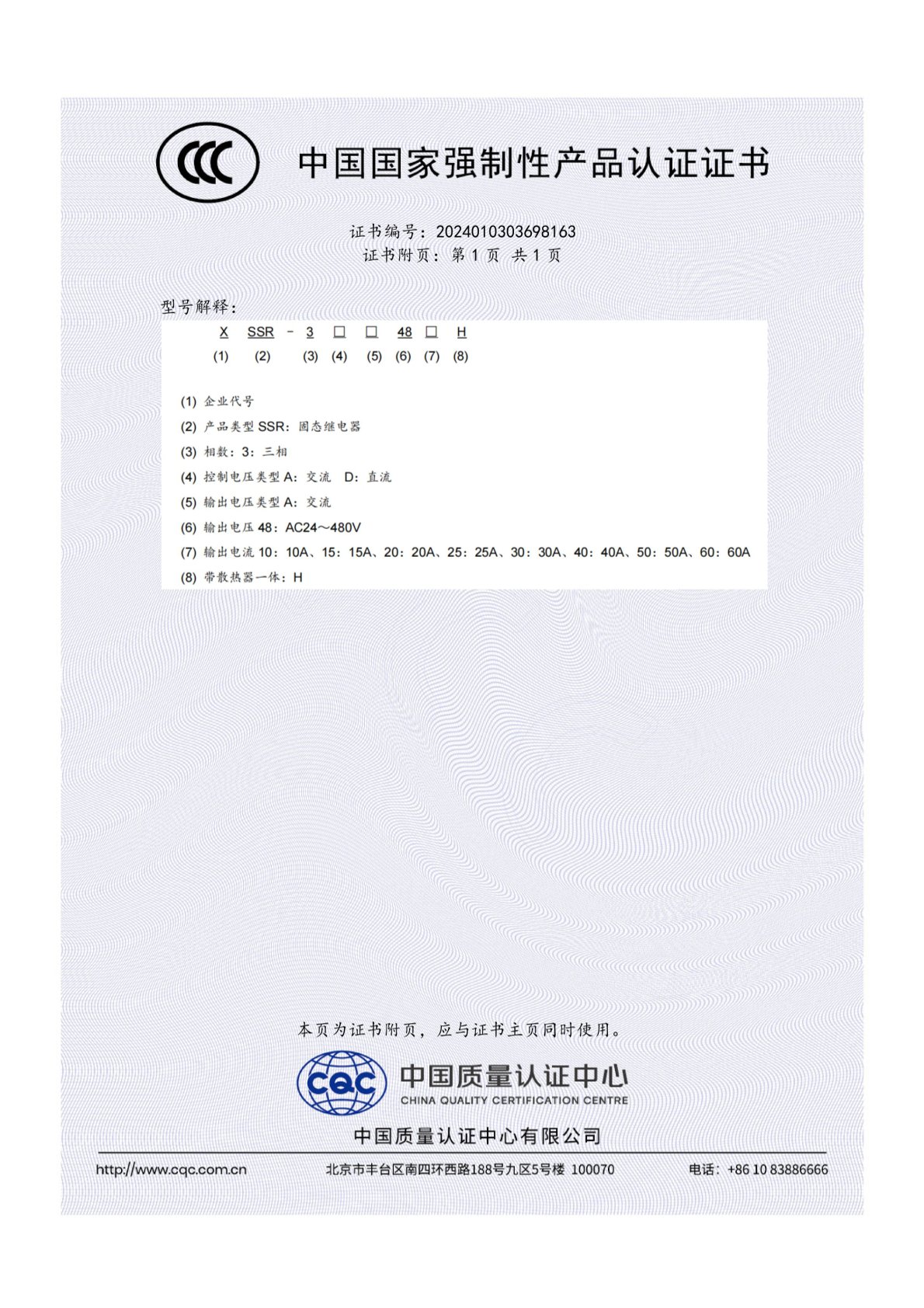
For control-panel builders following the DIN-rail trend, the XSSR-3H is the direct match. It switches AC loads from 24 VAC to 480 VAC at 10 A to 60 A, accepts 3–32 VDC (DA) or 80–250 VAC (AA) control signals, and uses a PA66 nylon housing with an aluminum base plate. The integrated DIN-rail module measures approximately 97 × 88 × 61 mm. This model holds a China Compulsory Certificate (CCC) under certificate number 2024010303698163, issued to GB/T 14048.5-2017, valid through 2029-09-29.
General-Purpose AC Loads and Heating: XSSR-W1 and XSSR-W2-JK
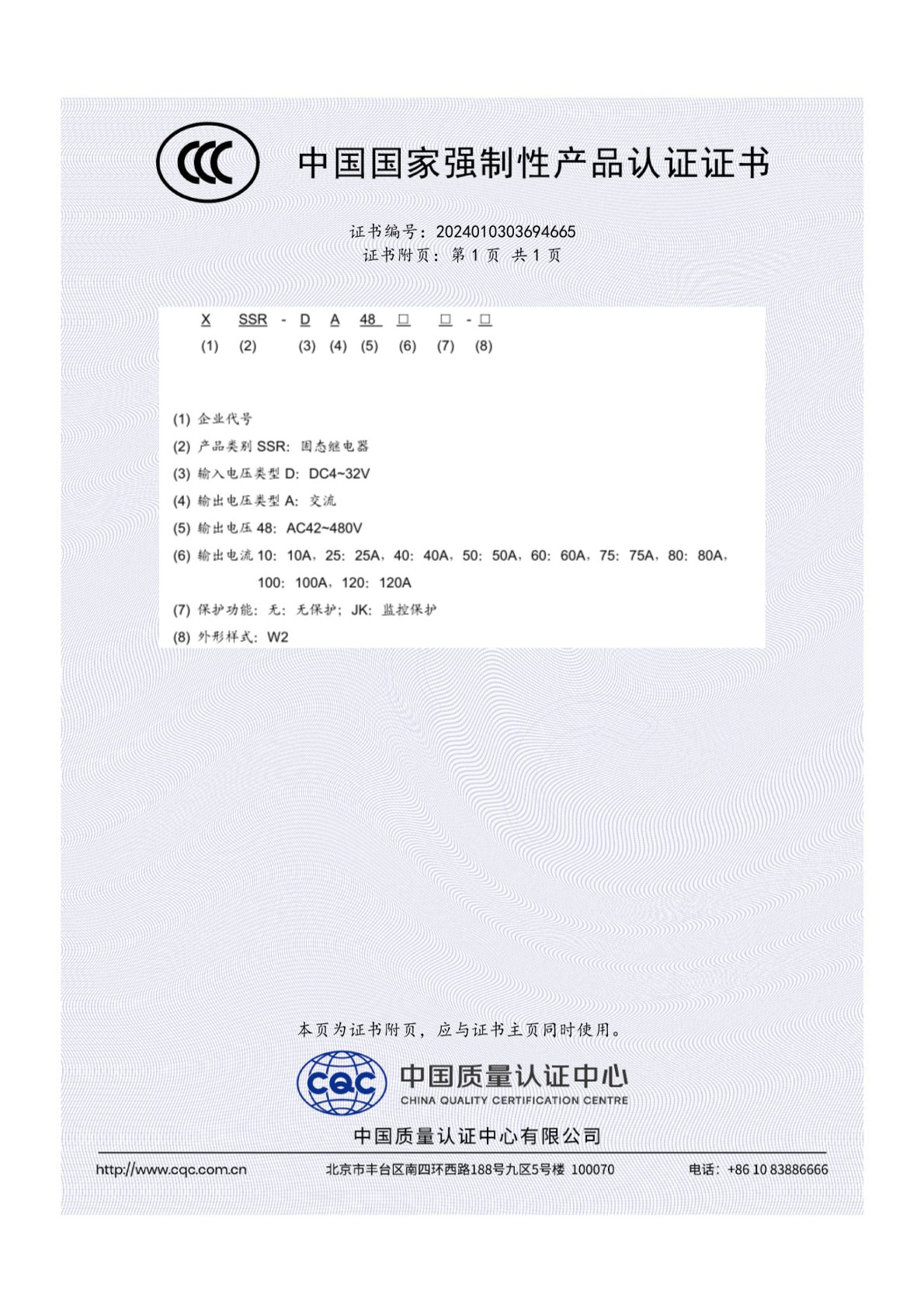
The XSSR-W1 covers 10 A to 100 A at 75–480 VAC and accepts either 3–32 VDC or 80–250 VAC control inputs. The XSSR-W2-JK offers 10 A to 120 A in the same voltage band with a 4–32 VDC control input. Both are screw-mount types with plastic housings and aluminum alloy base plates, making them suitable for heating systems, lighting, and general industrial power switching. The XSSR-W2-JK also holds CCC certification (certificate number 2024010303694665, GB/T 14048.5-2017, valid through 2029-09-18).
DC-to-AC Switching: DA Control Variants
For DC-to-AC solid state relay applications — where a DC control signal switches an AC load — the DA variants across the XSSR series accept 3–32 VDC control inputs while switching 24–480 VAC loads. This configuration is common in PLC-controlled heating and lighting systems, where a 24 VDC logic signal drives a 240 VAC or 480 VAC load without an additional interposing relay.
High-Current and Zero-Crossing Applications: XSSR-M1 to M6
For loads above 60 A, the XSSR-M1~M6 series extends from 60 A to 1000 A at 75–480 VAC. These modules use zero-crossing triggering, which reduces inrush current when switching resistive loads, and switch within ≤10 ms. The series is designed for heating systems, motor control, and industrial automation — the same application profile where a buyer in Malaysia deployed 800 units in PLC and conveyor systems and reported a 65% reduction in maintenance cost over two years with no major failures.
Medium-Current Series for 25A/40A-Class Requirements
Buyers searching for a 25A or 40A solid state relay will find those ratings distributed across the product line. The XSSR-W7 covers 5 A to 25 A at 24–240 VAC; the XSSR-F W2 covers 10 A to 60 A at 24–480 VAC with a compact 59 × 47 × 33.5 mm housing; the XSSR-W5 covers 10 A to 125 A at 75–480 VAC; and the XSSR-W6 and XSSR-W12 cover 10 A to 100 A and 10 A to 120 A bands respectively in the 75–480 VAC range with DA or AA control options.
Three-Phase and Adjustable (Phase-Angle) Control: XSSVR Series
When the application needs more than on/off switching, the XSSVR series adds analog control options. The XSSVR-VAW2 accepts 0–10 VDC or 0–5 VDC input and switches 0–240 VAC loads from 10 A to 120 A. The XSSVR-CA W2 accepts a 4–20 mA input for the same load range. The XSSVR-W1/W2 models are adjustable via an external potentiometer (470–560 kΩ) with a conduction angle range of 0–170°, covering 10 A to 40 A in W1 and 50 A to 200 A in W2. For three-phase systems, the XSSVR-3P handles 10 A to 200 A at 0–380 VAC with potentiometer, voltage, or current control inputs. These models are relevant to industrial heating, lighting dimming, and basic motor speed regulation.
Certification and Compliance: The Non-Negotiable Filter
Industrial solid state relays are required to comply with international safety standards including IEC/EN 60947-4-3 for contactors and motor-starters and UL 508 for industrial control equipment. For the Chinese market, GB/T 14048.5-2017 is the applicable standard under the CCC scheme.
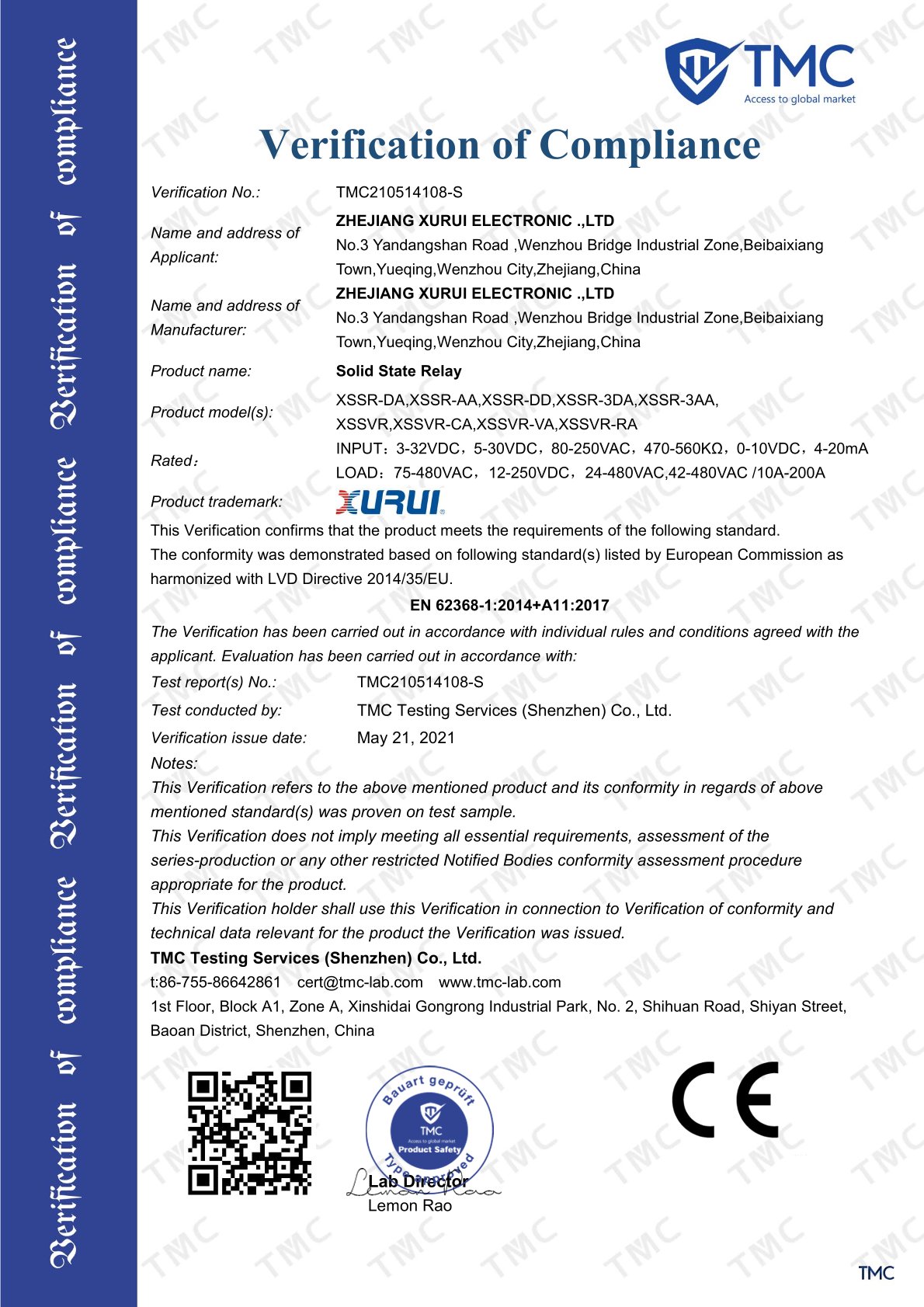
XURUI's SSR-specific certifications include a CE certificate for the XSSR series (certificate number TMC210514108-C, tested to EN62368-1:2014+A11:2017) and CCC certificates for the XSSR-3H and XSSR-W2-JK models. At the company level, XURUI states that its mainstream products carry CCC, CE, TÜV SÜD, UL, KC, and RoHS certifications. Third-party industry data additionally records that XURUI obtained UL approvals for its XV-15, XZ-15, and XZ-8 series switches and SSRs starting in 2010, and that the company holds more than 50 national patents. This combination of SSR-level and company-level compliance evidence gives buyers a verifiable basis for including XURUI in a qualified supplier list.
Step-by-Step: A Five-Stage SSR Evaluation Workflow for 2026
Use the following sequence to turn a vague 'I need a solid state relay' requirement into a specifiable part number.
Step 1 — Classify the Load and Apply the Safety Factor
Determine whether the load is resistive (heating elements, incandescent lighting), inductive (motors, solenoids), or capacitive (power supplies). XURUI specification data recommends a 50–60% load current safety factor for resistive loads and 30–40% for inductive loads. If the load draws 20 A and is inductive, select a relay rated at least 50 A to stay inside the safety margin.
Step 2 — Select the Mounting Format
Decide whether the relay will be mounted on a DIN rail inside a control panel or directly onto a panel surface via screw mounting. DIN-rail mount SSRs are the fastest-growing segment at 7.11% CAGR, while panel-mount remains the largest at 38.67% share. The XSSR-3H is the DIN-rail model in XURUI's line; the W, M, and XSSVR series use horizontal screw mounting.
Step 3 — Match Voltage and Current Ratings to the Real System
Confirm the load voltage (for example, 240 VAC or 480 VAC single-phase) and the maximum continuous current. The 0–20 A bracket represents 44.13% of global demand, but industrial control systems frequently specify 25 A and 40 A relays to preserve derating headroom. XURUI's XSSR line covers 5 A to 1000 A AC loads from 24 VAC to 480 VAC.
Step 4 — Verify Certifications Against Your Target Market
For EU/EEA projects, check CE compliance; for North America, UL recognition is the common requirement; for China, CCC is mandatory for relevant low-voltage apparatus. IEC/EN 60947-4-3 and UL 508 are the baseline standards for industrial SSR switching devices. XURUI's XSSR series carries CE, and the XSSR-3H and XSSR-W2-JK carry CCC certificates with verifiable certificate numbers.
Step 5 — Audit the Manufacturer's Production and Customization Capability
At the Evaluation stage, the supplier's ability to deliver consistent quality matters as much as the relay's datasheet. XURUI documents an OEM/ODM production mode with customization options for handle, logo, dimensions, and operating characteristics. Its SSR production capacity ranges from 5,000 to 250,000 units per month, with a standard lead time of 15–30 days, a minimum order quantity of 100 units, and 100% pre-shipment testing. These are concrete, auditable numbers that a buyer can verify during a factory audit or pilot order.
Use Cases: How Two Industrial Buyers Applied XURUI SSRs
Heating Control Systems in Germany: 1,200 Units of XSSR-W1
A German industrial equipment manufacturer deployed 1,200 XSSR-W1 relays in heating control systems over a three-year period. The documented result was a 60% reduction in maintenance cost and fewer reported mechanical failures. For industrial heating, the combination of AC load switching and the documented resistive-load safety margin makes the W1 a repeatable choice across multiple equipment builds.
PLC and Conveyor Systems in Malaysia: 800 Units of XSSR-M1 to M6
An industrial automation solution provider in Malaysia used 800 units from the XSSR-M1~M6 series in PLC control and conveyor systems over two years. The result was a 65% reduction in maintenance cost and zero major failures during operation. High-current zero-crossing switching, combined with the low maintenance profile of solid-state technology, supported continuous outdoor operation in this application.
Comparison Table: 2026 SSR Buyer Preference Signals vs. XURUI Product Responses
| Preference Axis | 2025 Market Signal | XURUI Series | Representative Specification |
|---|---|---|---|
| Mounting format | DIN-rail: fastest-growing, 7.11% CAGR | XSSR-3H | 10–60 A, 24–480 VAC, DIN-rail, approx. 97 × 88 × 61 mm |
| Low-current class | 0–20 A bracket: 44.13% of market | XSSR-W7 / W9 / F W2 | 5–25 A, 24–240 VAC / 5–20 A / 10–60 A, 24–480 VAC |
| 25A / 40A class | Common industrial ratings for derating margin | XSSR-W1 / W2-JK | 10–100 A / 10–120 A, 75–480 VAC |
| High-current switching | 60 A+ industrial automation demand | XSSR-M1~M6 | 60–1000 A, 75–480 VAC, zero-crossing trigger |
| Three-phase systems | Three-phase heating and motor control | XSSVR-3P | 10–200 A, 0–380 VAC, multiple control inputs |
| Analog / adjustable control | Heating, dimming, speed regulation | XSSVR-VAW2 / CA W2 / W1-W2 | 0–10 V/0–5 V or 4–20 mA input; 10–120 A |
Table data is based on XURUI product specifications (XSSR and XSSVR series) and third-party market data published by MarketsandMarkets and Mordor Intelligence. Certification status and certificate numbers should be re-verified against the latest supplier documentation before final specification.
FAQ
What certifications should an industrial solid state relay meet?
Industrial SSRs should meet the compliance framework applicable to their target market. Internationally, IEC/EN 60947-4-3 and UL 508 are widely recognized standards for industrial control and solid-state switching equipment. For China, GB/T 14048.5-2017 is the relevant CCC standard. XURUI's XSSR series carries a CE certificate (TMC210514108-C, EN62368-1:2014+A11:2017), and specific models such as the XSSR-3H and XSSR-W2-JK hold CCC certificates with numbers 2024010303698163 and 2024010303694665 respectively. Company-level certifications include CCC, CE, TÜV SÜD, UL, KC, and RoHS.
Does XURUI support OEM or ODM customization for solid state relays?
Yes. XURUI's documented production mode includes OEM/ODM with customization options for handle, logo, dimensions, and operating characteristics. The company's SSR production capacity is 5,000–250,000 units per month, with a minimum order quantity of 100 units. Each order is subject to 100% pre-shipment testing, and remote technical support is available after delivery.
How should buyers compare Chinese SSR manufacturers with international brands on cost?
Cost comparison should be based on total cost of ownership for a specific model, not on a single unit price. International brands such as Sensata (Crydom), OMRON, Carlo Gavazzi, Schneider Electric, Panasonic, and TE Connectivity are widely specified in global projects. Chinese manufacturers including XURUI generally offer different structural advantages: OEM/ODM flexibility, monthly capacity up to 250,000 units, lead times of 15–30 days, and direct manufacturer access for specification changes. Buyers should request a model-specific quotation and compare it against the required certification, derating, and after-sales support — not against an abstract brand average.
Can buyers request samples before a bulk solid state relay order?
Buyers can request samples and remote technical support to validate compatibility before committing to a volume order. XURUI performs 100% pre-shipment testing on every order, which reduces the risk of receiving non-conforming units in both sample and production batches. For sample requests, pricing, or technical documentation, contact Leon at Leon@chinaxurui.com or +86-577-62911448.
What is the typical lead time for solid state relay production at XURUI?
The standard lead time is 15–30 days, depending on model, specification, and order quantity. Monthly SSR capacity is 5,000–250,000 units, and the minimum order quantity is 100 units. To lock in lead time for a project, buyers should confirm technical parameters and certifications with the manufacturer early in the procurement cycle. The full product catalog and company profile can be downloaded here: XURUI Company & Product Brochure (PDF).
Conclusion: Build the 2026 SSR Shortlist Around Verified Preferences
The 2026 SSR market is not asking buyers to choose between obscure technical novelties. It is asking them to align with three observable preferences: DIN-rail mounting for panel efficiency, 25 A–40 A ratings for derating headroom in the dominant low-to-medium current band, and certification evidence as a non-negotiable filter. The product data, certification records, and documented use cases in this article give an Evaluation-stage buyer a practical framework for building a qualified shortlist.
XURUI's XSSR product line responds to these preferences with a broad current range, DIN-rail and screw-mount formats, CE and CCC certifications, and auditable OEM/ODM capacity. For buyers moving from evaluation to specification, the next step is to verify the specific model against the load, download the technical catalog, and request a quotation with the required certifications.
Next step: Download the XURUI Company & Product Brochure (PDF) to review SSR series specifications, or contact Leon at Leon@chinaxurui.com / WhatsApp +86 13968773211 for sample and quotation support.
Have Questions or Need More Details?
Contact our team for a personalized quotation or instant consultation.
Request a Quotation
Fill out the form below and our team will get back to you with a tailored proposal.
WhatsApp Direct Chat
Prefer to chat in real-time? Message us on WhatsApp for instant assistance & quick answers.
- Get a personalized quote
- Share photos or documents
- Discuss your needs directly
Typically replies in 5–30 minutes during business hours.