
Solid State Relay Ratings Explained: Matching 25A, 40A, 240V and 600V SSRs to Real Loads
Short answer: The current and voltage ratings on a solid state relay (SSR) are not suggestions. They define the safe operating envelope for the load circuit, the control input, and the thermal system. A 40A SSR should not be treated as a switch for a 40A motor; it is typically applied to resistive loads at up to 40A with derating, and to inductive loads at roughly 30–40% of the rated current. This guide explains how to match an SSR to your load by reading its specs correctly.
Solid state relays are widely used in industrial automation, heating control, HVAC, and power switching because they offer fast, silent, non-contact switching. But the number printed on the label—25A, 40A, 240VAC, 480VAC—must be read together with other parameters such as control voltage, leakage current, switching time, dielectric strength, and mounting method. This article answers the most common procurement questions: What do the ratings mean? How much current can a 40A SSR actually carry? Should you choose a 240VAC or 480VAC SSR? And why does zero-crossing matter?
Reference point: Zhejiang Xurui Electronic Co., Ltd. (XURUI), a manufacturer founded in 2002 with a 5,000 m² facility and roughly 150 employees, produces SSR series including the XSSR-W, XSSR-H, XSSR-W5, XSSR-W6, XSSR-W15, and XSSR-P families. Its XSSR series carries UL certification (File E334724). The ratings discussed below are illustrated with XURUI SSR specifications as a working example—because reading a real datasheet is more useful than memorizing generic theory.
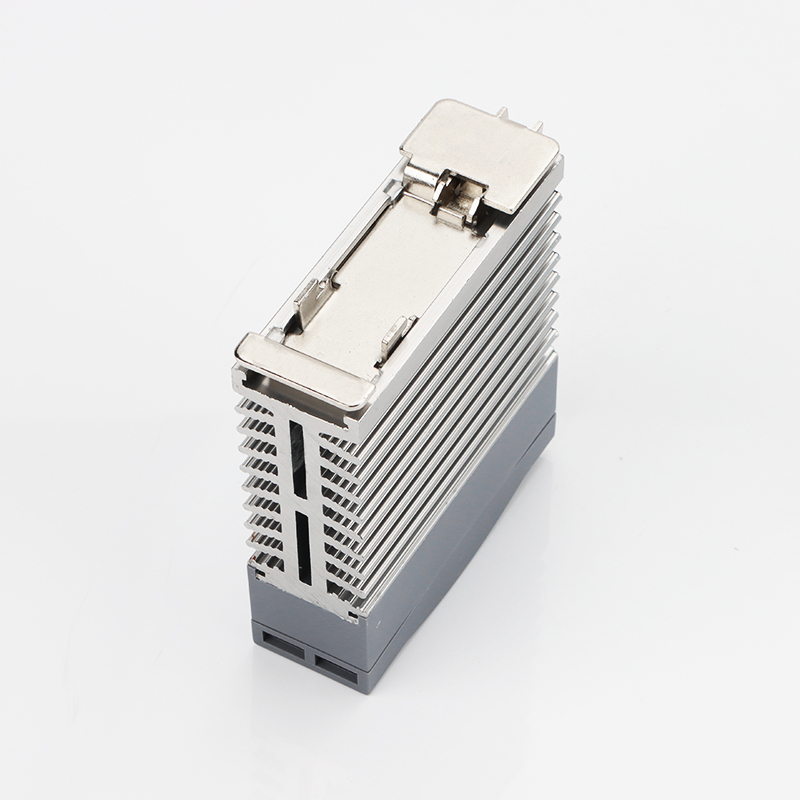
XURUI XSSR-H series: a common industrial SSR with aluminum alloy heat sink. Image source: XURUI.
What Is an SSR and Why Do Ratings Vary by Series?
A solid state relay is an electronic switching device that uses semiconductor components such as thyristors or TRIACs to switch AC or DC loads. Unlike an electromechanical relay, an SSR has no moving contacts, which eliminates arcing, reduces wear, and enables faster switching.
SSR ratings vary by series because each series is designed for a different mounting style, current range, and application profile. For example:
- XSSR-W15: Horizontal bolt mount, plastic housing, load voltage 75–480VAC, max load current 10A–200A.
- XSSR-W6: Load voltage 75–480VAC, max load current 10A–100A, available with DC or AC control.
- XSSR-H: 24–480VAC load voltage, 5A–60A max load current, with aluminum alloy heat sink.
- XSSR-P1/P2/P3: PCB-mount style, 24–240VAC, up to 2A, for low-current control boards.
This is why “solid state relay” as a keyword is too broad. Selecting an SSR requires comparing at least three sets of numbers: control input, load output, and environmental limits.
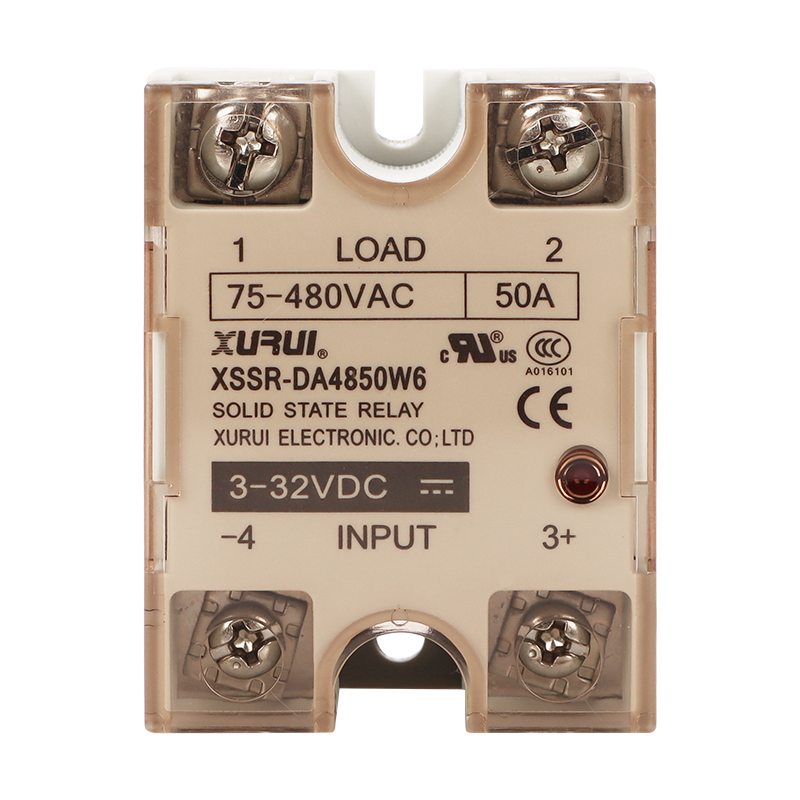
XURUI XSSR-W6: load voltage 75–480VAC, current range 10A–100A. Image source: XURUI.
HVQ 2: What Certification and Rating Constraints Should I Verify Before Buying an SSR?
When buyers search for “certified solid state relay” or “UL solid state relay,” they are usually in the evaluation stage. Before purchasing, verify three categories of constraint: compliance certifications, electrical ratings, and thermal limitations.
1. Certification Constraints
Industrial SSRs are typically expected to comply with international standards. For industrial control equipment, the commonly cited standards are IEC/EN 60947-4-3 (low-voltage switchgear and controlgear) and UL 508 (industrial control equipment).
For example, XURUI holds UL recognition for its XSSR series under certificate number 20170124-E334724, covering the XSSR-W2-JK, XSSR-W6, and XSSR-F W2 models. The scope is “Low-voltage electrical apparatus,” based on UL 508 and CSA C22.2 No. 14. If your application targets North America, this type of documentation matters during panel inspection.
For mainland China projects, CCC certification is another relevant mark. XURUI’s SSR series including W1, W6, and W12 is certified under certificate 2024010303694597 to GB/T 14048.5-2017, issued by CQC. The XSSR-3H DIN-rail model is covered by CCC certificate 2024010303698163.
Certification constraints also differ by region. If the relay will be sold or installed in the EU, CE marking—with a declaration based on the applicable harmonized standard—is typically expected. The verified data above also notes that IEC/EN 60947-4-3 and UL 508 are the international standards that industrial SSRs are required to comply with. Always ask the supplier for the certificate number and scope, not just a logo.
2. Electrical Rating Constraints
Electrical rating constraints are the numbers that determine whether an SSR can handle your circuit. The critical parameters are:
- Load voltage range (e.g., 75–480VAC): The SSR is designed to switch loads within this range.
- Max load current (e.g., 10A–100A): The highest continuous current allowed under stated conditions.
- Min load current (e.g., 0.08A): Below this, the SSR may not switch reliably.
- Control voltage (e.g., 3–32VDC or 80–250VAC): The input signal needed to turn the SSR on.
- Output leakage current (e.g., ≤5mA): The small current that flows through the output even when off.
- Switching time (e.g., ≤10ms): How quickly the output responds to the control signal.
The following table lists representative XURUI SSR series and their key electrical constraints, so you can see how rating packages differ between model families.
| XURUI Series | Load Voltage | Max Load Current | Control Voltage | Mounting | Typical Use |
|---|---|---|---|---|---|
| XSSR-W15 | 75–480VAC | 10A–200A | 3–32VDC / 80–250VAC | Horizontal bolt mount | Heating, motor control, industrial automation |
| XSSR-W6 | 75–480VAC | 10A–100A | 3–32VDC / 80–250VAC | Bolt mount | Heating, lighting, AC motor control |
| XSSR-W5 | 75–480VAC | 10A–125A | 3–32VDC | Bolt mount | High-current heating, industrial automation |
| XSSR-H | 24–480VAC | 5A–60A | 3–32VDC / 80–250VAC | With aluminum heat sink | Industrial automation, HVAC, medical equipment |
| XSSR-3H | 24–480VAC | 10A–60A | 3–32VDC / 80–250VAC | DIN-rail mount | Motor control, power switching, heating |
| XSSR-P1/P2/P3 | 24–240VAC | 2A | 5V / 12V / 24VDC | PCB mount | Low-current control boards |
3. Thermal and Load-Type Constraints
Thermal management is often the hidden constraint. An SSR’s current-carrying capability is limited by the heat generated at the semiconductor junction. The XSSR-H series uses an aluminum alloy heat sink; the XSSR-W1 uses an aluminum alloy base plate. For the XSSR-H, the catalog safety factor is 50–60% for resistive loads and 30–40% for inductive loads. This means:
- A resistive heater drawing 25A should be paired with an SSR rated around 40A or higher.
- A motor or other inductive load drawing 25A should be paired with an SSR rated well above the motor’s full-load current—often 60A or higher.
- Enclosure temperature, mounting torque, and airflow all affect the actual current that can be carried continuously.
These derating rules are the most commonly ignored part of SSR selection. A 40A SSR is not a “40A switch” for every load type; the safety factor depends on the load.
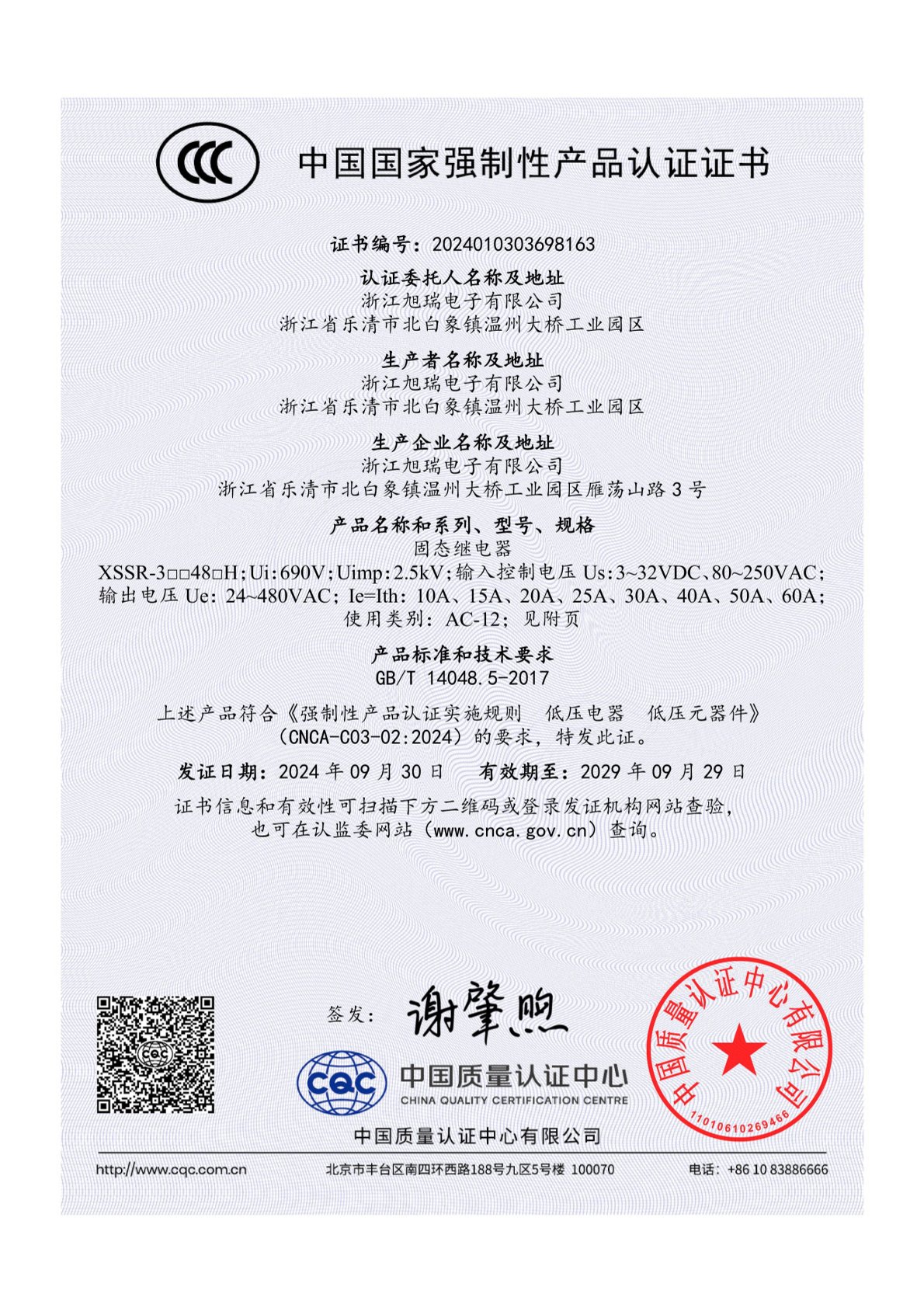
CCC certificate for XURUI XSSR-3H, issued by China Quality Certification Centre. Image source: XURUI.
How to Interpret Common SSR Ratings: 25A, 40A, 240V, 480V, 600V
Buyers often search for “25A solid state relay,” “40A solid state relay,” “240V solid state relay,” or “600V solid state relay.” These search terms reflect the tendency to select an SSR by one headline number. A more reliable method is to map each number to a specific circuit boundary.
Load Current: 25A vs. 40A
The load current rating is the maximum continuous current that the SSR’s output is designed to carry under specific conditions. For real applications:
- 25A SSR: Suitable for resistive loads up to roughly 25A continuous, with proper heat sinking. For an inductive load, consider application at only 30–40% of rated current—around 8–10A for a motor.
- 40A SSR: A common choice for 25A resistive heating circuits and similar loads. Recommended safety factors are 50–60% for resistive loads, meaning a 40A SSR is often used where the steady-state load is between 20A and 24A.
- Min load current: Check the datasheet. Many XURUI models specify 0.08A; below this value, the SSR’s output may not latch properly.
In practice, “25A” and “40A” are starting points, not final values. The duty cycle, ambient temperature, and heat sink size should be part of the final calculation.
Load Voltage: 240VAC vs. 480VAC vs. 600VAC
Load voltage ratings matter because an SSR must be able to block the peak voltage of the supply, not just the RMS value. A 240VAC SSR is intended for nominal 220–240VAC systems. A 480VAC SSR is used for 400–480VAC three-phase or line-to-line systems. A 600VAC SSR, where available, provides additional margin for industrial power systems.
The XURUI SSR families listed above mostly cover 75–480VAC or 24–480VAC. For a 220VAC heater, a 24–480VAC SSR such as the XSSR-W6 or XSSR-H provides ample voltage headroom. For a 480VAC industrial heating bank, choose a series explicitly rated to 480VAC, such as the XSSR-W15 or XSSR-W5.
Note that a “220VAC solid state relay” does not mean the SSR can only control 220VAC. It usually means the SSR is suitable for 220VAC circuits, but the actual specified range may be broader, such as 24–480VAC. Always read the range, not just the nominal voltage.
Control Voltage: DC-Controlled vs. AC-Controlled SSRs
SSRs are classified by their control input:
- DC-controlled (DA): Typically 3–32VDC control voltage and 6–25mA control current. Common in PLC and microcontroller outputs.
- AC-controlled (AA): Typically 80–250VAC control voltage and 5–25mA control current. Used when the control signal is derived directly from an AC line.
For example, the XSSR-W6 has two ordering forms: XSSR-DA48□□W6 with 3–32VDC control, and XSSR-AA48□□W6 with 80–250VAC control. The important control specifications are the guarantee-ON voltage (≥3VDC for DA, ≥80VAC for AA) and guarantee-OFF voltage (≤1VDC for DA, ≤30VAC for AA). These thresholds determine whether your PLC signal will reliably turn the SSR on and off.
Zero-Crossing vs. Random-On SSRs
A zero-crossing SSR turns on its output only when the AC voltage waveform crosses zero. This reduces inrush current and electromagnetic interference, making it preferred for resistive loads such as heaters. A random-turn-on SSR can switch at any point in the waveform, which is useful for phase-angle control or applications that require fast response.
The XURUI XSSR-M1~M6 series specifies a zero-crossing trigger method, and its switching time is ≤10ms with load voltage 75–480VAC and load current from 60A to 1000A (depending on model). For heating applications, zero-crossing behavior is usually the safer default.
Mounting and Form Factor: DIN-Rail vs. Panel Mount vs. PCB Mount
Mounting configuration affects both installation cost and panel density. Verified market data indicates that panel-mount SSR designs held the largest mounting configuration share at 38.67% in 2025, while DIN-rail variants are the fastest-growing segment with a forecasted CAGR of 7.11%. XURUI covers all three forms:
- DIN-rail mount (XSSR-3H): Integrated module housing, approximately 97 × 88 × 61 mm, with 24–480VAC load voltage and 10A–60A current. Suitable for control cabinets that use standardized rail mounting.
- Panel/bolt mount (XSSR-W1, W5, W6, W15): Horizontal bolt mount with plastic housing and aluminum base plate, designed for direct panel mounting with or without an external heat sink.
- PCB mount (XSSR-P1/P2/P3): Low-current (2A max), 24–240VAC, for integration on printed circuit boards.
Choosing between DIN-rail and panel mount is a cabinet-level decision. DIN rail reduces installation time; panel mount often provides better thermal contact to the enclosure. Both can be valid for 25A or 40A loads; the deciding factors are panel space, heat dissipation strategy, and assembly workflow.
How to Select an SSR for a Specific Application: A Step-by-Step Method
The following method works for most industrial SSR selections, whether you are buying 10 units or 10,000.
Step 1: Classify the load type
Determine whether the load is resistive (heaters, incandescent lamps), inductive (motors, solenoids, transformers), or capacitive. Most SSR catalogs provide different safety factors: XURUI lists 50–60% for resistive loads and 30–40% for inductive loads.
Step 2: Measure or calculate the steady-state load current
Use the nameplate current of the load, not the breaker rating. For a heater, this is straightforward. For a motor, consider starting current and locked-rotor current, which can be several times the full-load current.
Step 3: Apply the safety factor
For resistive load:
SSR rated current ≥ Load current ÷ 0.5 to 0.6.
For inductive load:
SSR rated current ≥ Load current ÷ 0.3 to 0.4.
Example: A 25A resistive heater should use an SSR rated at least 25 ÷ 0.5 = 50A. Many buyers choose a 40A SSR because the heater draws less than 40A, but the recommended safety margin—if the manufacturer specifies it—may require a higher rating. This is one of the most common sources of premature SSR failure.
Step 4: Check control signal compatibility
If your PLC outputs 24VDC, choose a DC-controlled SSR with a 3–32VDC range. If the control signal is 220VAC, choose an AC-controlled model with an 80–250VAC range. Verify the control current is within the driver’s capability.
Step 5: Select the load voltage range
Choose an SSR whose load voltage range covers your supply voltage. For a 220VAC circuit, 24–480VAC is a safe choice. For 480VAC, use an SSR explicitly rated for 480VAC, such as the XSSR-W5, XSSR-W6, or XSSR-W15.
Step 6: Define mounting and thermal strategy
For a DIN-rail cabinet, choose a DIN-rail SSR such as the XSSR-3H. For high-current panel mounting, choose a bolt-mount series with an aluminum base plate. Use a properly sized heat sink and, if necessary, forced-air cooling. The XSSR-H series includes an aluminum alloy heat sink, making it a more integrated choice for medium-current applications.
Step 7: Verify certifications
Finalize the shortlist only after checking that the exact model has the certification required by your project. For North American panels, verify UL recognition; for China, verify CCC; for EU, request CE documentation. Keep the certificate numbers on file.
Case Data: How XURUI SSRs Performed in Real Installations
Case references help translate ratings into real outcomes. Two XURUI SSR cases illustrate how current ratings and application type interact.
- Industrial Automation Solution Providers (Malaysia, 800 units, 2 years): Used XSSR-M1~M6 SSRs in PLC control systems and conveyor systems. The reported outcome was maintenance cost reduced by 65% and zero major failures during operation. The SSR series is zero-crossing, with load voltage 75–480VAC and a current range of 60A–1000A depending on model.
- Industrial Equipment Manufacturers (Germany, 1,200 units, 3 years): Used XSSR-W1 SSRs in heating control systems. The reported outcome was maintenance cost reduced by 60% and fewer mechanical failures. The XSSR-W1 covers 75–480VAC and 10A–100A.
These cases do not prove that a specific rating works for every installation. They show that large-batch buyers in industrial automation and heating control have used XURUI SSR families in long-running projects with reported reductions in maintenance cost. Your load profile still determines which rating package is correct.
Comparison: What to Check When Evaluating SSR Suppliers
Because buyers often compare multiple SSR suppliers, the table below lists the most useful comparison criteria and what to check for each. It is not a ranking; it is a verification checklist.
| Comparison Criterion | Why It Matters | What to Ask / Look For |
|---|---|---|
| Certification coverage | Determines whether the SSR can be legally used in your target market or panel application. | Ask for the certificate number, issuing body, model list, and expiry date. For XURUI XSSR, UL E334724 and CCC 2024010303694597 are documented. |
| Current rating and safety factor | Prevents premature failure caused by overload or inadequate derating. | Ask for the recommended safety factor for resistive and inductive loads. XURUI lists 50–60% resistive and 30–40% inductive for XSSR-H. |
| Control compatibility | Ensures the SSR can be driven by your PLC, thermostat, or switch. | Verify control voltage and current: e.g., 3–32VDC / 6–25mA for DA models. |
| Mounting flexibility | Affects cabinet layout, cooling, and assembly cost. | Confirm DIN-rail, panel-mount, and PCB options. XURUI covers XSSR-3H (DIN rail) and W-series (bolt mount). |
| Quality control | Reduces field failure and warranty disputes. | Ask whether the supplier performs 100% pre-shipment inspection. XURUI states 100% strict inspection before delivery. |
| Manufacturing capability | Matters for OEM/ODM buyers who need custom ratings or branding. | Check monthly capacity, lead time, and MOQ. XURUI capability unit lists 15–30 days lead time, 100-unit MOQ, and OEM/ODM support. |
Use Cases: Which SSR Rating Group Fits Which Job
Heating control with 40A resistive load
For a 220VAC heating circuit drawing up to 25A, a 40A-rated SSR such as the XSSR-W6 or XSSR-H is a common starting point—but check the manufacturer’s derating guidance. For a 40A steady-state resistive load, a higher-rated SSR, such as the XSSR-W5 (10A–125A), may be more appropriate.
Motor control with 25A inductive load
Motors are inductive and draw high inrush current. Applying an inductive safety factor of 30–40% means a 25A motor could need an SSR rated around 60A or more. The XSSR-W15 with a 10A–200A range allows designers to choose a rating package that provides sufficient headroom.
DIN-rail control cabinet with 220VAC load
For a control cabinet using DIN-rail mounting, the XSSR-3H (24–480VAC, 10A–60A) is designed for this form factor. It also holds a CCC certificate (2024010303698163), which is relevant for projects requiring China Compulsory Certification.
PCB-level switching for low-power signals
For low-current loads up to 2A at 24–240VAC, PCB-mount relays such as the XSSR-P1/P2/P3 are more practical than large panel-mount SSRs. Their control voltages cover 5VDC, 12VDC, and 24VDC.
Frequently Asked Questions
1. What certifications should a solid state relay have for industrial use?
Industrial SSRs are generally expected to comply with recognized safety standards. The most relevant international standards are IEC/EN 60947-4-3 and UL 508. For North American installations, a UL-recognized SSR is preferred. For mainland China, CCC certification is relevant. As an example, XURUI’s XSSR series is UL-recognized under file E334724 (20170124-E334724), and SSR series including W1, W6, and W12 hold CCC certificate 2024010303694597 to GB/T 14048.5-2017. Check the certificate name, model scope, and issuing body before you buy.
2. Can a 25A or 40A solid state relay switch a motor directly?
Technically yes, but only with sufficient headroom. Motors are inductive loads and draw inrush current much higher than the steady-state current. For inductive loads, XURUI recommends a safety factor of 30–40% of rated current. For example, an XSSR-H series SSR rated 40A should be considered for an inductive load of roughly 12A–16A, not 40A. If the motor draws 25A, choose an SSR rated at least 60A and verify the heat sink design.
3. What is the difference between a 240V and a 480VAC solid state relay?
A 240VAC SSR is intended for nominal 220–240VAC circuits, while a 480VAC SSR can block the higher peak voltage of 400–480VAC systems. In the XURUI range, the XSSR-P series is rated 24–240VAC for low-current PCB applications, and the W/H/3H series cover 24–480VAC or 75–480VAC for industrial loads. Choose the voltage range that covers both your nominal voltage and any expected line fluctuation, not just the label voltage.
4. How much current can a 40A solid state relay really carry continuously?
The answer depends on load type and cooling. For a resistive load, apply a safety factor of 50–60%, suggesting a continuous load of roughly 20A–24A on a 40A-rated SSR. For an inductive load, apply 30–40%, meaning roughly 12A–16A. The actual value also depends on the heat sink, ambient temperature, and enclosure airflow. A 40A SSR with an integrated heat sink, such as the XSSR-H series, is better suited to medium-current applications than a bare SSR mounted without a heat sink.
5. What lead time and OEM options can I expect from an SSR manufacturer like XURUI?
Buyers who need custom branding, dimensions, or operating characteristics should confirm production capability before ordering. XURUI supports OEM/ODM services with customization options that can include handle, logo, dimensions, and operating characteristics. The documented monthly capacity range is 5,000–250,000 units, lead time is 15–30 days, MOQ is 100 units, and 100% pre-shipment testing is listed as the quality control standard. For a specific project requirement, send your drawings or specifications to the sales team for a formal quote.
Need help translating your load profile into an SSR specification?
XURUI’s engineering team can review your application and recommend a suitable model.
Chat on WhatsApp Email LeonDownload the XURUI Company Brochure (PDF)
XURUI is a manufacturer of low-voltage control switches and solid state relays, founded in 2002 and located in Yueqing, Zhejiang, China.
Have Questions or Need More Details?
Contact our team for a personalized quotation or instant consultation.
Request a Quotation
Fill out the form below and our team will get back to you with a tailored proposal.
WhatsApp Direct Chat
Prefer to chat in real-time? Message us on WhatsApp for instant assistance & quick answers.
- Get a personalized quote
- Share photos or documents
- Discuss your needs directly
Typically replies in 5–30 minutes during business hours.