
Supplier Evaluation: Verifying a Solid State Relay Maker's Testing and Failure-Analysis Capabilities
A solid state relay supplier can clear a price review and still fail in the field. The difference usually sits in two places a quotation never shows: how finished units are tested before they leave the line, and how the manufacturer documents what happens when a unit fails. This guide sets out a supplier-audit methodology for solid state relay (SSR) manufacturers — what to request in advance, what to inspect during a factory visit or a virtual audit, and what counts as acceptable evidence of production consistency. Zhejiang Xurui Electronic Co., Ltd. (XURUI), a China-based switch and relay manufacturer founded in 2002, is used as a worked reference, because its published specification sheets and certification records can be checked line by line rather than taken on trust.
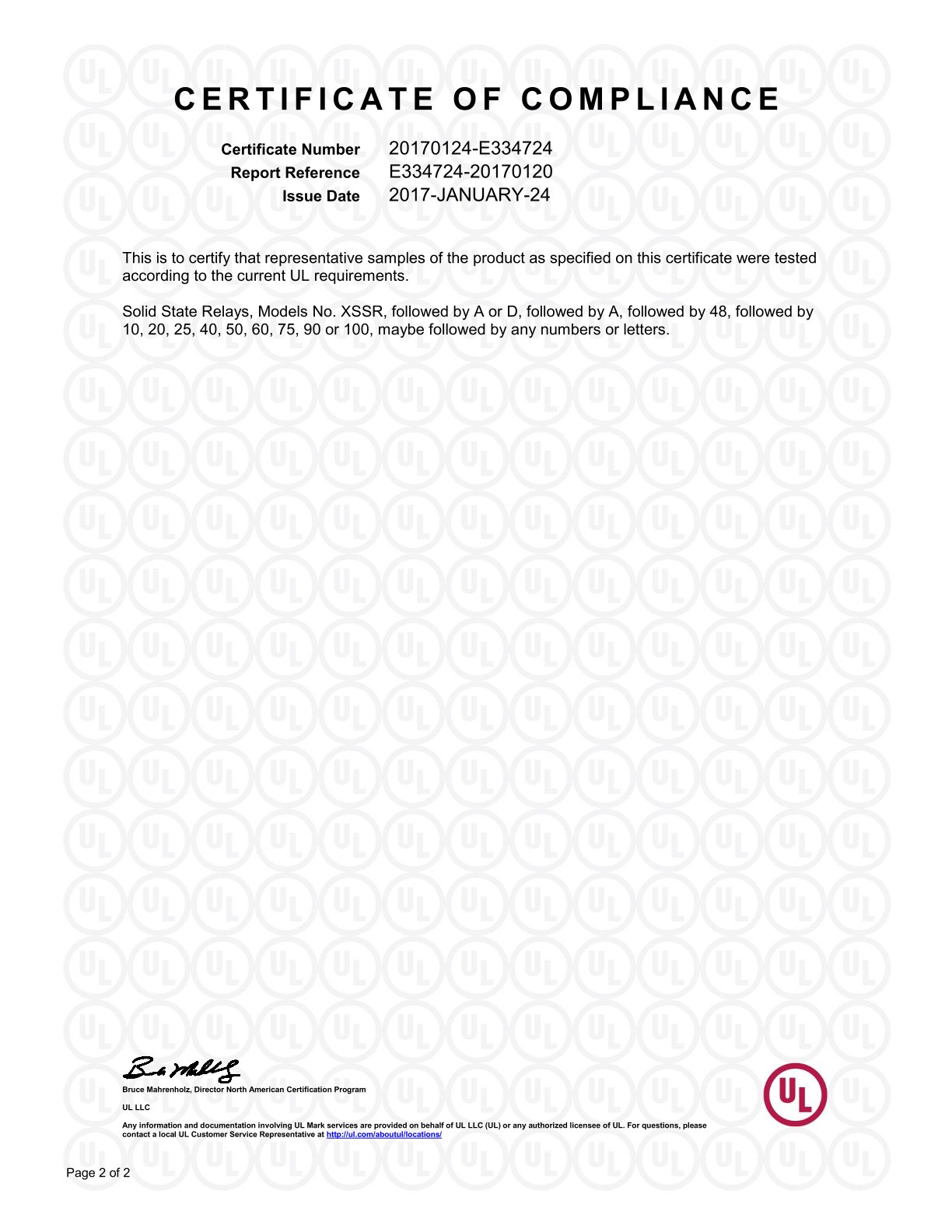
UL certification file 20170124-E334724, issued by UL LLC on 24 January 2017, covers the XSSR-W2-JK, XSSR-W6 and XSSR-F W2 solid state relays.
Problem Definition: Why a Quotation Cannot Prove Testing Capability
Most SSR sourcing decisions are made on four data points: unit price, lead time, minimum order quantity, and whether a certification logo appears on the datasheet. None of those four tells a buyer whether the units in a specific shipment were individually tested, against which parameter and limit, or what the supplier does with the units that fail.
That gap produces a predictable failure pattern. A batch passes incoming inspection, then drifts out of specification several months into a heating, motor-control or lighting duty cycle, and the buyer discovers there is no batch-level test record to compare against. The problem is rarely dishonesty. It is that the buyer never requested the evidence that would have made the supplier's claim verifiable in the first place.
A practical framing for the audit is this: a testing claim is only as strong as the documentation behind it. “100% tested” is a marketing sentence until someone asks which parameter was measured, at which limit, recorded where, and retained for how long. The same logic applies to failure analysis — a policy for handling failures is not the same thing as a written record of failures that were actually analysed, corrected, and closed.
Three evidence layers to keep separate
- Layer 1 — Design evidence: the specification sheet. It states the intended limits, such as a dielectric strength of ≥2500 VAC or a switching time of ≤10 ms.
- Layer 2 — Unit evidence: the per-unit or per-batch test record. It shows whether the goods actually shipped inside those limits.
- Layer 3 — System evidence: the quality-management and certification records that make Layer 2 auditable, such as ISO 9001 processes and third-party certificates with traceable certificate numbers.
A supplier that can produce Layers 1 and 3 but not Layer 2 is a supplier whose consistency cannot be verified. Detecting exactly that condition is the purpose of the protocol described below.
Industry Background: What the SSR Market and Its Standards Actually Require
The global solid-state relay market was estimated at USD 1.74 billion in 2025 and is projected to reach USD 2.36 billion by 2030 (MarketsandMarkets). Asia-Pacific accounts for an estimated 42% of that market in 2025, driven by EV charger deployment and photovoltaic inverter manufacturing in China and Japan (Mordor Intelligence). On the demand side, panel-mount designs held the largest mounting configuration share at 38.67% in 2025, DIN-rail variants are the fastest-growing segment with a forecasted 7.11% CAGR, and the 0–20 ampere current bracket accounted for 44.13% of market size in 2025 (Mordor Intelligence).
Those figures matter to a supplier audit for one reason: at this volume, a marginal test-coverage decision at the factory becomes a material reliability decision in the field. One percentage point of untested output scales into thousands of installed units across a heating panel, a conveyor line, or a lighting control cabinet.
On the compliance side, industrial solid state relays are expected to comply with international safety standards including IEC/EN 60947-4-3 (contactors and motor-starters) and UL 508 (industrial control equipment). Those standards define the safety envelope a product must operate inside. They do not define how thoroughly a manufacturer tests each unit within that envelope — which is precisely why supplier evaluation has to extend past the certificate. Certification confirms that a design was validated. It does not describe what happened on the production line last week.
XURUI’s position in this market is relevant to the audit. The company manufactures a solid state relay line covering DIN-rail modules such as the XSSR-3H and screw-mounted or panel-mounted modules such as the XSSR-W2-JK, XSSR-W6, XSSR-M1~M6 and XSSR-F W2, alongside micro switches, limit switches, foot switches, toggle switches, reed switches, proximity switches and photoelectric switches. A manufacturer with a broad multi-category switch portfolio carries a different production-consistency risk profile than a single-line assembler, because shared test equipment, shared quality systems and shared documentation practices must hold across more than one product family.
Detailed Solution: What a Verifiable Testing and Failure-Analysis Capability Contains
The short answer is that a verifiable capability consists of three things that can be examined independently: published electrical limits, an inspection routine that is actually applied to shipped goods, and certification records whose numbers can be checked against the issuing body. XURUI states that it applies a 100% pre-shipment test to its output and that it supports OEM and ODM production across a monthly capacity range of 5,000–250,000 units, with a stated lead time of 15–30 days. Supporting that operating claim are an engineering team of more than 24 R&D engineers, more than 60 national independent patents, ISO 9001 quality-system certification, and product certifications including CCC, CE, TÜV SÜD, UL, KC and RoHS. The company operates a 5,000+ m² factory with approximately 150 employees and an annual output of 20 million units, and exports roughly 40% of production to markets including the United States, Germany, Japan, South Korea, Turkey, Belgium and Egypt.
None of those statements is self-validating. Each one maps to something a buyer can ask to see, which is what turns a supplier claim into an audit finding.
Electrical test parameters an auditor can re-measure
The XURUI solid state relay range publishes dielectric strength of ≥2500 VAC across the XSSR-3H, XSSR-W2-JK, XSSR-W6, XSSR-M1~M6 and XSSR-F W2 series. Switching time is published as ≤10 ms, and insulation resistance is 2100 MΩ on the XSSR-3H and XSSR-F W2 and ≥100 MΩ on the XSSR-W2-JK, XSSR-W6 and XSSR-M1~M6. Output leakage current is ≤5 mA on most series, with ≤7 mA on some XSSR-M series models and ≤8 mA on the XSSR-3H.
These are the four parameters that matter most in a test-bench audit, because each one is measurable on a sample pulled from finished stock. Dielectric strength and insulation resistance are the safety-critical pair: they indicate whether the isolation barrier is intact. Switching time and leakage current are the performance pair: they indicate whether the unit will behave the way the panel design assumes when it is installed. A supplier that can demonstrate the test on a random unit, rather than only on a datasheet, has effectively answered the Layer 2 question.
Thermal verification beyond the headline rating
The published operating temperature for the XURUI SSR series is −20°C to +70°C. That rating is a design limit, not a test result, and a competent audit treats it as such. The more informative numbers are the published load-current safety factors on the XSSR-W2-JK and XSSR-H: 50–60% for resistive loads and 30–40% for inductive loads. Those figures describe how the manufacturer expects a unit to be derated in real service, which is where most thermal failures originate.
An auditor should therefore ask two questions. First, how is the operating-temperature rating validated — by design calculation, by type test on a sample, or by full thermal cycling? Second, how are the published derating factors translated into application guidance for buyers who are switching inductive loads such as motor starters or transformer primaries? A supplier that can explain its derating logic is generally a supplier that has seen field returns and learned from them.
Certification records that can be verified independently
Certification evidence is the easiest layer to audit, because the numbers are checkable. XURUI holds UL certification under file 20170124-E334724, issued by UL LLC on 24 January 2017 against UL 508 and CSA C22.2 No. 14, covering the XSSR-W2-JK, XSSR-W6 and XSSR-F W2 solid state relays. For the Chinese market, CCC certificate 2024010303698163 covers the XSSR-3H under GB/T 14048.5-2017, issued by the China Quality Certification Centre on 30 September 2024 and valid to 29 September 2029. A second CCC certificate, 2024010303694665, was issued for the XSSR-W2 JK scope on 19 September 2024 and is valid to 18 September 2029, with a stated scope covering industrial automation, power control systems, HVAC systems and electrical switching applications.
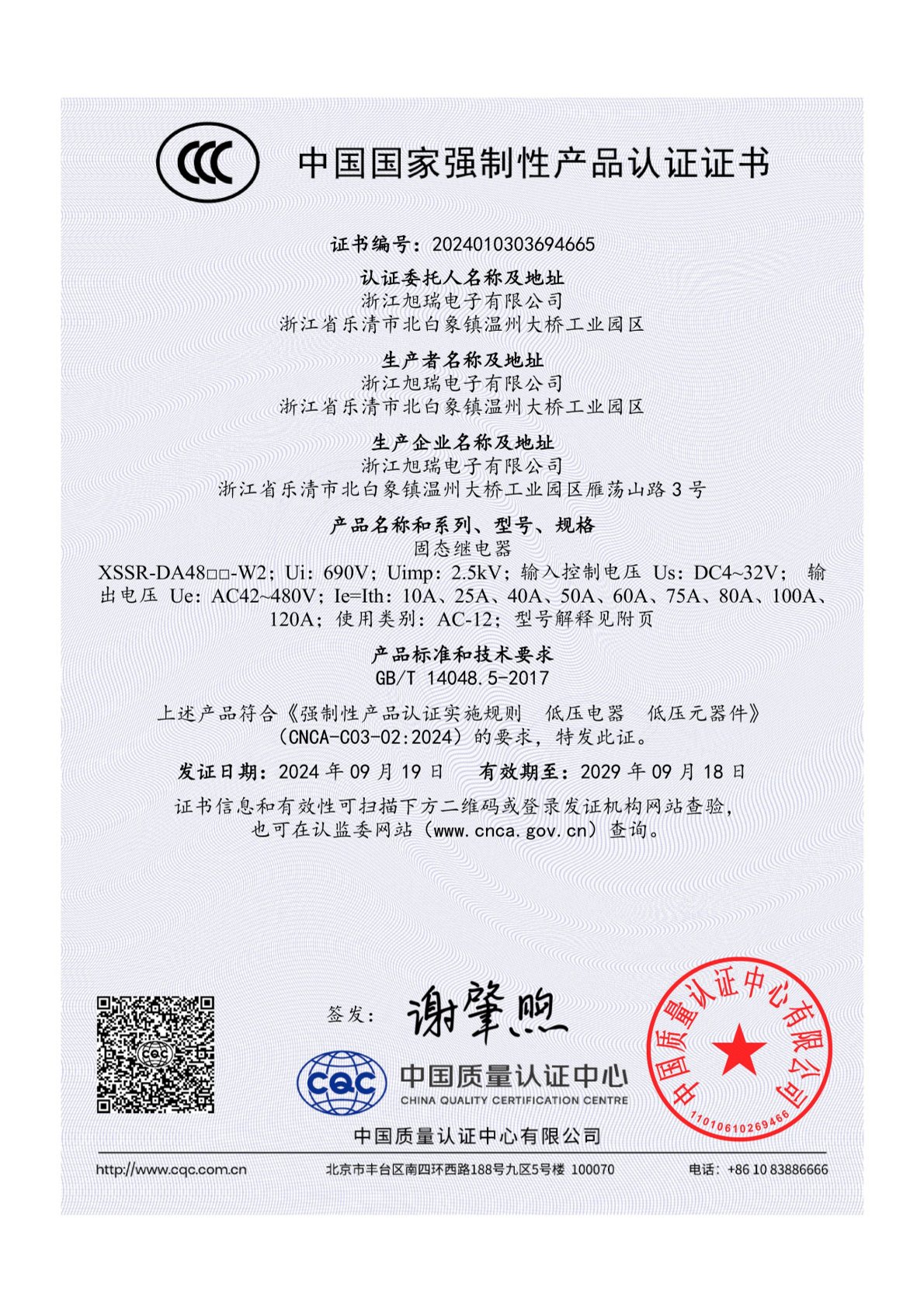
CCC certificate 2024010303694665 covers the XSSR-W2 JK scope under GB/T 14048.5-2017, issued by the China Quality Certification Centre.
The audit action here is simple and frequently skipped: look up the file number, confirm the model designations listed, and confirm the certificate is still within its validity window. A certificate that covers a sibling model but not the part number in your purchase order is not evidence for your order.
Failure-mode documentation: what to ask for
Failure analysis is the part of a supplier audit where buyers most often accept a verbal answer. A policy — “we analyse returned units and issue a corrective action” — is a statement of intent. Documentation is a record of execution. The useful request is for the record format itself, not a summary of it: what fields are captured when a unit is returned, who performs the analysis, how the root cause is classified, and how a corrective action is linked back to a production batch.
The practical test is whether a returned unit can be traced to a production date. If the answer is yes, the supplier can narrow a failure to a specific batch, a specific test-station operator, or a specific incoming component lot. If the answer is no, then every failure is effectively a one-off, and the same defect can recur without anyone noticing the pattern.
Audit rule of thumb: a supplier that can show batch-level traceability does not need to claim perfect quality. A supplier that cannot show it has no mechanism for improving quality over time, regardless of what its certification folder contains.
Step-by-Step Breakdown: A Six-Step Audit Protocol for SSR Manufacturers
The protocol below is designed to work both for an on-site visit and for a remote audit conducted over video with document sharing. The order matters: document requests come first, so that the physical inspection can be used to challenge specific claims rather than to collect generic impressions.
-
Issue the document request list before the audit date
Request the current specification sheet for the exact model in scope, the certificate numbers and issuing bodies for every certification claimed, the quality-system certificate, and a sample batch test record with the parameter values and pass limits visible. For XURUI, the model in scope would be a specific series such as the XSSR-3H, XSSR-W2-JK, XSSR-W6, XSSR-M1~M6 or XSSR-F W2, not a general product category. Asking for the exact model prevents the common outcome where the audit proves capability for a part number you are not buying.
-
Inspect the test bench against the published limits
The datasheet publishes dielectric strength, insulation resistance, switching time and leakage current. The audit should confirm that test equipment on the line is configured to those same limits, and that the operator can explain the pass/fail threshold. Where a supplier states a 100% pre-shipment test, this is the step that converts the statement into an observation: you either see units flowing through the station or you do not.
-
Verify the thermal and derating logic
Ask how the −20°C to +70°C operating range is validated, and how the published load-current safety factors of 50–60% for resistive loads and 30–40% for inductive loads are applied in application support. A supplier that can walk through a derating calculation for an inductive load is demonstrating engineering capability, not just a test fixture.
-
Trace one production batch end to end
Pick one finished-goods carton and trace it backwards: to the test record, to the production date, and to the incoming component lot. This single exercise tests traceability, record-keeping and process discipline at the same time. It also reveals how records are stored — paper folders, a spreadsheet, or an electronic system — which tells you how quickly the supplier could respond to a field problem.
-
Read the failure record, not the failure policy
Request the last few completed failure analyses, redacted as needed, and read the root-cause classification and the corrective action. Look for whether the corrective action is tied to a batch or to an individual unit. A pattern of unit-level fixes with no batch-level follow-up is a signal that the analysis loop is not actually closing.
-
Confirm commercial consistency with the technical findings
Testing capability has to survive the production schedule. XURUI publishes a monthly capacity range of 5,000–250,000 units, a stated lead time of 15–30 days, and a minimum order quantity of 100 units, with EXW delivery terms, TT payment terms and pre-shipment test as the stated acceptance criterion. If the requested volume sits near the top of a supplier’s monthly capacity range, test coverage is the first thing that quietly erodes, so the capacity figure and the 100% pre-shipment test claim should be checked against each other.
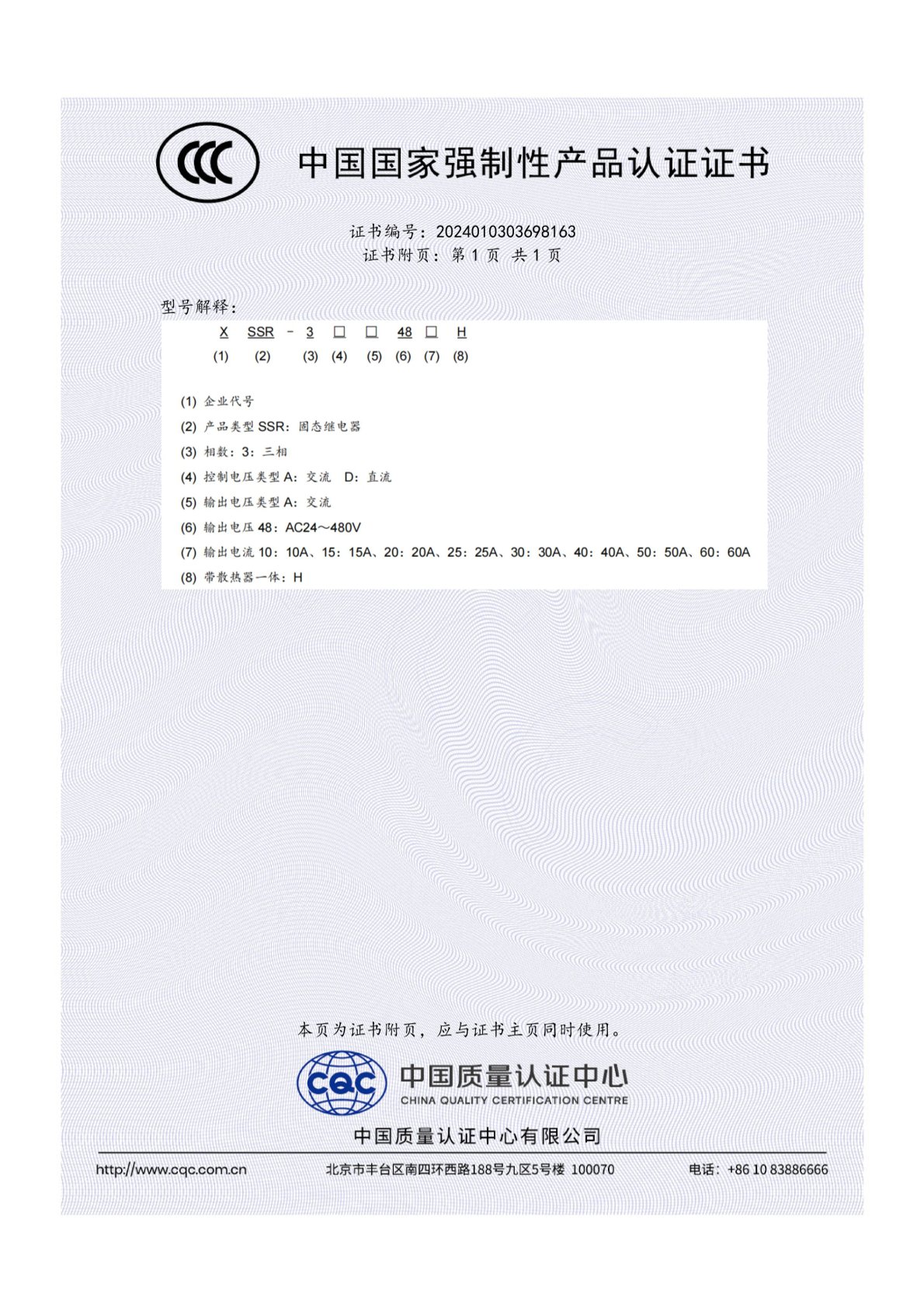
CCC certificate 2024010303698163 covers the XSSR-3H under GB/T 14048.5-2017, issued by the CQC and valid to 29 September 2029.
Use Cases: Where Testing Evidence Changes the Buying Decision
Testing and failure-analysis capability is not an abstract quality topic. It shows up in operating outcomes, and the SSR cases below illustrate the scale at which the difference becomes visible.
PLC and conveyor control in Malaysia. An industrial automation solution provider integrated 800 units of the XSSR-M1~M6 series into PLC control systems and conveyor systems. Over a two-year operating period, the buyer reported maintenance cost reduced by 65% and zero major failures during operation. The XSSR-M1~M6 series publishes a load current range of 60 A–1000 A, with the M1 model covering 60–200 A and the M6 covering 700–1000 A, and uses zero-crossing triggering. For an auditor, the relevant question is which of the published parameters — dielectric strength, leakage current, or thermal derating — was monitored to produce that outcome, because that is the parameter to re-verify on the next order.
Heating control in Germany. An industrial equipment manufacturer deployed 1,200 units of the XSSR-W1 series in heating control systems, reporting maintenance cost reduced by 60% and fewer mechanical failures across a three-year period. The XSSR-W1 publishes a load voltage range of 75–480 VAC, a maximum load current of 10–100 A, and a dielectric strength of ≥2500 VAC. Heating duty cycles are a classic thermal-cycling environment, which makes this the type of installation where an operating-temperature claim of −20°C to +70°C and a documented derating rule are worth more than a certificate alone.
DIN-rail panel builds. For panel builders standardising on DIN-rail modules, the XSSR-3H publishes a load voltage of 24–480 VAC, a maximum load current of 10 A–60 A, a minimum load current of 0.08 A, a dielectric strength above 2500 VAC, insulation resistance of 2100 MΩ, and DIN-rail mounting in an integrated module housing. The published reference dimensions are approximately 97 × 88 × 61 mm, varying by current rating. In an audit, the mounting configuration is where the testing question becomes a consistency question: if the same housing platform serves multiple current ratings, the test routine has to distinguish them.
Comparison Table: Published SSR Parameters to Verify During an Audit
The table below lists the parameters an auditor can use as a verification checklist. Every value is drawn from the manufacturer’s published specification sheet for the respective series.
| Series | Control voltage | Load voltage | Max load current | Dielectric strength | Insulation resistance | Switching time | Mounting |
|---|---|---|---|---|---|---|---|
| XSSR-3H | 3–32 VDC or 80–250 VAC | 24–480 VAC | 10 A–60 A | >2500 VAC | 2100 MΩ | ≤10 ms | DIN-rail, integrated module housing |
| XSSR-W2-JK | 4–32 VDC | 42–480 VAC | 10 A–120 A | ≥2500 VAC | ≥100 MΩ | ≤10 ms | Not stated on the published sheet |
| XSSR-W6 | 3–32 VDC or 80–250 VAC | 75–480 VAC | 10–100 A | ≥2500 VAC | ≥100 MΩ | ≤10 ms | Not stated on the published sheet |
| XSSR-M1~M6 | 3–32 VDC | 75–480 VAC | 60 A–1000 A (M1: 60–200 A; M6: 700–1000 A) | ≥2500 VAC | ≥100 MΩ | ≤10 ms | Screw mount, modular enclosure, zero-crossing trigger |
| XSSR-F W2 | 3–32 VDC | 24–480 VAC | 10 A–60 A | ≥2500 VAC | 2100 MΩ | ≤10 ms | Horizontal screw mounting |
Two audit observations follow from this table. First, dielectric strength and switching time are consistent across the range, which means a single test-bench routine can cover multiple series — and a single routine is easier to verify than five separate ones. Second, insulation resistance is not uniform: the XSSR-3H and XSSR-F W2 publish 2100 MΩ, while the XSSR-W2-JK, XSSR-W6 and XSSR-M1~M6 publish ≥100 MΩ. An auditor should confirm that the test station is configured to the correct limit for the specific model being produced, rather than to a single default value.
Where a value is not published — as with mounting detail for the XSSR-W2-JK and XSSR-W6 — the correct audit response is to request it directly, not to infer it. Inference is how buyers end up with a compliance assumption that was never verified.
Frequently Asked Questions
1. Which certification records should I verify before approving a solid state relay supplier?
Verify certificate numbers against the issuing body and confirm that the part number in your purchase order is actually listed. XURUI holds UL certification under file 20170124-E334724, issued by UL LLC on 24 January 2017 against UL 508 and CSA C22.2 No. 14, covering the XSSR-W2-JK, XSSR-W6 and XSSR-F W2 solid state relays. For the Chinese market, CCC certificate 2024010303698163 covers the XSSR-3H under GB/T 14048.5-2017 and is valid to 29 September 2029, while CCC certificate 2024010303694665 covers the XSSR-W2 JK scope and is valid to 18 September 2029. Industrially, SSRs are also expected to comply with IEC/EN 60947-4-3 and UL 508, so any certificate should reference a recognisable standard.
2. What testing capability should an SSR manufacturer be able to demonstrate during an audit?
At minimum, the ability to show a live test against the published limits: dielectric strength, insulation resistance, switching time and output leakage current. On the XURUI range, dielectric strength is published as ≥2500 VAC across the XSSR-3H, XSSR-W2-JK, XSSR-W6, XSSR-M1~M6 and XSSR-F W2; insulation resistance is 2100 MΩ on the XSSR-3H and XSSR-F W2 and ≥100 MΩ on the other series; switching time is ≤10 ms; and leakage current is ≤5 mA on most series. XURUI states that it applies a 100% pre-shipment test, and supports that with an engineering team of more than 24 R&D engineers and more than 60 national independent patents.
3. What commercial terms should be confirmed during the evaluation stage?
Confirm the terms in writing, because they determine how much risk sits with the buyer on the first order. XURUI publishes a minimum order quantity of 100 units, EXW delivery terms, TT payment terms, and pre-shipment test as the stated acceptance criterion. Monthly capacity is stated as a range of 5,000–250,000 units, and the company exports approximately 40% of its annual output of 20 million units to markets including the United States, Germany, Japan, South Korea, Turkey, Belgium and Egypt. Matching your forecast against the stated capacity range is the cheapest form of risk assessment available at this stage.
4. How should a first article or pilot batch be validated?
Use the acceptance criterion as the anchor. Because pre-shipment test is the stated acceptance standard and the minimum order quantity is 100 units, a pilot batch can be scoped at that level and evaluated on the test record rather than on visual inspection alone. Request the measured dielectric strength, insulation resistance and switching time values for that batch, and compare them against the published limits for the specific series. If the model in scope has published derating factors — for example the 50–60% resistive and 30–40% inductive load-current safety factors published for the XSSR-W2-JK and XSSR-H — confirm that the application guidance you received matches those figures. This is also the moment to test the supplier’s response time, since a pilot batch is the first real test of the working relationship.
5. What lead time and production capacity can be expected from XURUI?
XURUI publishes a lead time of 15–30 days and a monthly capacity range of 5,000–250,000 units, with OEM and ODM production supported and customization options covering handle, logo, dimensions and operating characteristics. After-sales support is described as remote support. If a project needs a full specification set before the order is placed, the XURUI product brochure can be downloaded at the XURUI brochure page, and specification questions can be sent to Leon@chinaxurui.com.
Conclusion: Testing Evidence Is the Real Deliverable
Verifying a solid state relay manufacturer’s testing and failure-analysis capability comes down to three requests that any buyer can make before a purchase order is issued: show the current specification sheet for the exact model, show a batch test record with the measured values against the published limits, and show one completed failure analysis with a corrective action tied to a production batch. A supplier that can answer all three is demonstrably different from one that can only produce a certificate folder.
The standards context supports this approach rather than replacing it. IEC/EN 60947-4-3 and UL 508 define the safety envelope; certificate numbers such as UL file 20170124-E334724 or CCC certificate 2024010303698163 confirm that a design was validated against it. Neither tells you what happened on the line during the week your units were built. That is the layer of evidence the audit has to reach.
For buyers evaluating XURUI specifically, the published record provides a starting point rather than a conclusion: a dielectric strength of ≥2500 VAC and switching time of ≤10 ms across the SSR range, a stated 100% pre-shipment test, an engineering team of more than 24 R&D engineers, more than 60 national independent patents, and a documented run of SSR deployments including 800 units of the XSSR-M1~M6 series in Malaysian PLC and conveyor systems and 1,200 units of the XSSR-W1 series in German heating control systems. Each of those statements can be verified — which is exactly what makes them worth asking about.
Zhejiang Xurui Electronic Co., Ltd. is based at NO.3 Yandangshan Road, Wenzhou Bridge Industrial Park, Beibaixiang Town, Yueqing, Wenzhou City, Zhejiang, China, and manufactures low-voltage control switches and solid state relays for industrial and consumer applications. More information is available at xuruiswitch.com.

XURUI operates a 5,000+ m² manufacturing facility with an annual output of 20 million units.
Request the Testing and Certification Documentation
Buyers preparing a supplier audit can download the full XURUI product brochure, including solid state relay series specifications and certification references, or send a model-specific documentation request directly to the sales team.
Brochure: Download the XURUI product brochure
Email: Leon@chinaxurui.com
Tel: +86-577-62911448
WhatsApp: +86 13968773211
Have Questions or Need More Details?
Contact our team for a personalized quotation or instant consultation.
Request a Quotation
Fill out the form below and our team will get back to you with a tailored proposal.
WhatsApp Direct Chat
Prefer to chat in real-time? Message us on WhatsApp for instant assistance & quick answers.
- Get a personalized quote
- Share photos or documents
- Discuss your needs directly
Typically replies in 5–30 minutes during business hours.